
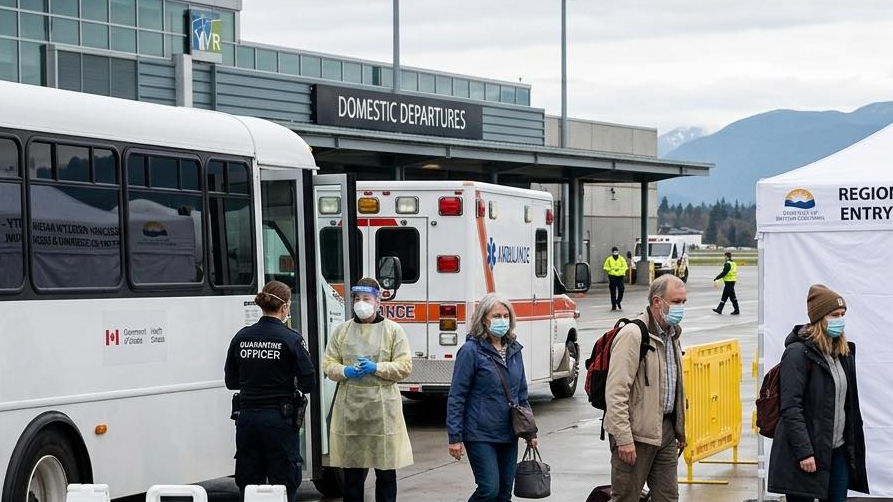
Four Canadians who were caught up in a deadly hantavirus outbreak aboard a cruise ship have finally set foot on home soil, arriving in Canada on Sunday after weeks of strict isolation and an internationally coordinated evacuation effort. The passengers, all with ties to British Columbia, landed first in Quebec before being transferred to the province where they will continue their quarantine under close health supervision.
The four were among 130 passengers evacuated from the MV Hondius, which docked at the port of Granadilla in Tenerife, one of Spain’s Canary Islands. Dressed in hazmat suits and respirators, passengers descended onto the tarmac and were sprayed with disinfectant before boarding a flight chartered jointly by the Public Health Agency of Canada and Global Affairs Canada, with logistical support from the Canadian Armed Forces.
The outbreak, declared by the World Health Organization in early May, has resulted in five confirmed hantavirus cases and three deaths. The disease, which typically spreads through inhaling particles from rodent droppings and waste, has so far shown limited person-to-person transmission a fact health officials are leaning on to reassure the public.
All four Canadians tested negative for symptoms before departure and are expected to complete a total quarantine of 21 days, calculated from May 6 the date the last confirmed case was present on board. Health officials will then assess whether an extended isolation period of up to 42 days from last possible exposure is needed.
Dr. Henry moved to calm public concerns, particularly those shaped by memories of the COVID-19 pandemic. She acknowledged the anxiety that follows any news of an infectious disease outbreak, noting that when she first heard about the situation, her own reaction was visceral. But she was firm that hantavirus operates very differently from respiratory pathogens and does not carry pandemic potential.
Beyond the four returning passengers, other Canadians have also been caught up in the outbreak’s wider net. A couple from Ontario’s Grey Bruce region disembarked before the outbreak was officially declared and have shown no signs of illness. Four additional Canadians from Quebec, Alberta, and Ontario were never on the ship but may have crossed paths with an infected passenger during a flight and are now in precautionary isolation.
WHO Director-General Tedros Adhanom Ghebreyesus separately addressed the public on Sunday, reiterating that the overall risk to the general population remains low. Still, the images from Tenerife painted a different picture passengers in full hazmat gear, sprayed with disinfectant on the airport tarmac, as port workers in protective equipment managed the evacuation with military precision.
Back in B.C., health teams say they will maintain daily contact with the arriving Canadians throughout their quarantine. Officials were careful to emphasize that the passengers will remain fully isolated from the community, with both their physical and mental health needs attended to during what has been by any measure a deeply unsettling ordeal at sea.

