
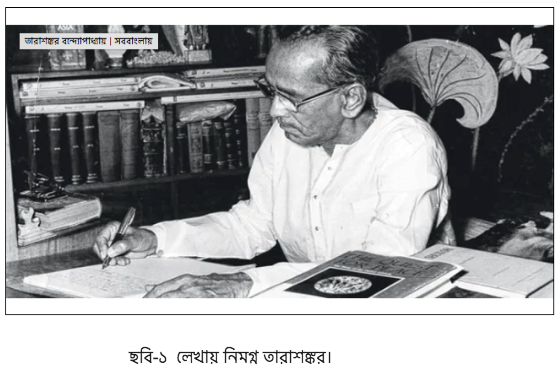
Visitors to Tarashankar’s residence:
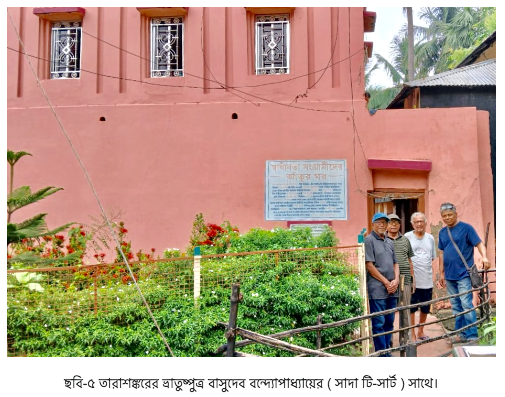
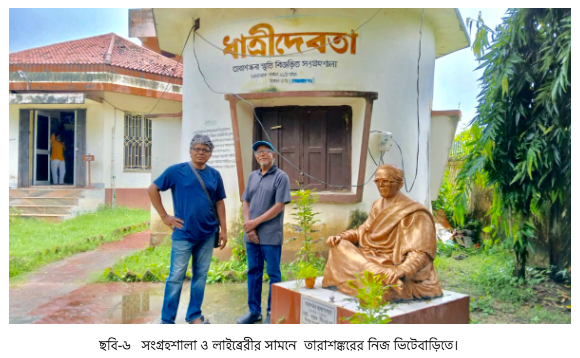
As we move through life, we drift with the flow of time. He brought the stream in a prosperous moment, last 27/8/2024 to visit the birthplace of Tarashankar at Lovepur Gaon near Santiniketan. I, the author of this article Nanigopal Debnath along with my nephew Anup Debnath and my Buetian classmate Sukumar Biswas came here to witness a rare memory, returned with a touch of fascination and wonder. And maybe these buildings of literary culture will never be seen. With this truth, I said goodbye, O star of the literary sky. The buildings are today preserved as Heritage Property. That is the house, conservatory, library and living room. In some parts the northern men of the family still live. They came out of Atur’s house with Vasudev Bandyopadhyay, nephew of Tarashankar, who still lives in the main house. They told the novelist that as they saw him, many poets and writers came to the house where he used to write.
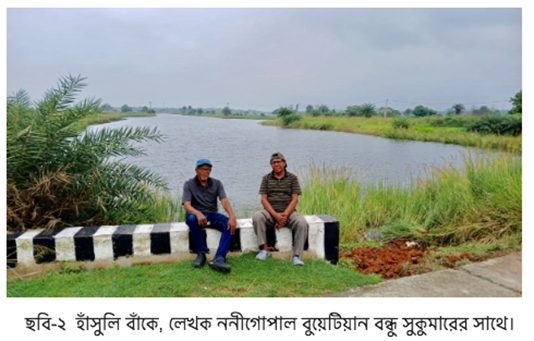
‘Hansuli Banker Upakatha’ is the epic novel of the last phase of Tarashankar’s first series. This novel was shortlisted for the Nobel Prize in 1970 and 1971. It is thought that he did not win because his English translation was not good, but in fact he passed away in 1971. The Nobel is usually awarded in lifetime. . I wandered around the Hansuli bend of Kopai river in Lovepur, took photos and wanted to find Tarashankar in the bend of life.
By writing 65 novels, 53 collections of short stories, 12 plays, 4 collections of essays, 4 memoirs, 2 travelogues and a book of poetry, Tarashankar continues to be a star of the literary world.
Many of his novels and stories have become the story of Bengali cinema, not unknown to you, even an express train novel in West Bengal named Ganadevta, we were lucky enough to travel on the Ganadevta Express. Salute to you Tarashankar.
Tarashankar Bandyopadhyay (1898 – 1971), born in Lovepur village of West Bengal’s Birbhum district, {note that Lovepur is only 45 m from Santiniketan in Bolpur: drive by car}. The work of this eminent fiction writer of the 20th century is immense. Tarashankar was a practitioner of literary pursuits for more than four decades. Tarashankar was born into a decadent zamindar family, the problems of that family and elements of public life in the Lovepur-adjacent region later became the main features of his novels.
After passing the matriculation examination from Lovepur School in 1916, he was admitted to St. Xavier’s College, Calcutta for higher education. But due to poor health and active participation in politics (anti-British movement) he could not complete his education. In 1930 he was arrested as a result of political movement. He met Rabindranath Tagore for the first time in 1932 at Santiniketan.
Throughout his life, Tarashankar has collected material for his novels from the public life of his familiar rural terrain. Although his novels had scope for imagination, they were mainly based on real life and social images.
Starting with Chaitali Vhirti, Tarashankar wrote one or two novels almost every year until his death in 1971. Mysteriously, the novel written in the year of his death is called Shatabdi Mrita.
Following are the names of Tarashankar’s novels which are well known to the regular readers:
Pashanpuri, Nilakantha, Raikamal, Love and Need, Fire, Dhatridevata, Kalindi, Ganadevata, Manvantar, , Storm and Rain, Abhiyan, Footsteps, Uttarayana, Hansulibanker’s Tale, Nagini Kanya’s Story, Arogya Niketan, Champadanga’s Bride, Panchaputli, Judge, Saptapadi, Radha, Human Mind, Dakharakara, No, Nagarika, Nishipadma, Kanna, Kalvaishakhi, Manjari Opera, Sanket, Vasantaraga, Swargamartya, Vichitra, Hirapanna, Mahanagari, Gurudakshina, Shuksari Katha, Shakkarbai, Manibaudi, Chayapatha, Kalratri, Actress, Fariyad and Shatabdi death
The Santal, Bagdi, Bostam, Bauri, Dom, Kahar and rural Kabial communities of the Birbhum-Burdwan region are particularly found in Tarashankar’s writings. Be it small or big people, Tarashankar has brought out the greatness of people in all his writings, which is the greatest quality of his writings. Various images of social change are the subject of many of his stories and novels. There is also talk of the destruction of village life, the development of city life.
His works can be divided into two parts in terms of characters. The first is the story of the joys and sorrows of unreformed brothers of the lower class society based on rural life, and the second is a story written in a political context. Up to the first part ‘The Tale of Hansuli Banker’. And another part from ‘Manvantar’ to the present day.
Three Bandyopadhyay bearers of Rabindranya novelists have shown genuine achievement in novel writing during almost the same period. Among them Tarashankar Banerjee is the most prominent among them. In fact, like the other two Bandyopadhyays (Vibhutibhushan and Manik), he wrote in a unique style with the novelty of the subject, but he equally nourished the style of Bankim-Saratchandra.
Another specialty of Tarashankar’s literary career was drama, which began with ‘Maratha Darpan’. Later he wrote original dramas like ‘Pather Dak’, ‘Bingsh Shatabdi’, ‘Kalratri’, ‘Yugbiplob’, ‘Dui Purush’, ‘Dwipantar’, ‘Sanghat’, ‘Vigraha-Pratishta’ and other short story adaptations and ‘Kalindi’. , ‘Kabi’, ‘Arogya Niketan’ etc. gave dramatization of novels. Although his innate talent was revealed in drama, his home field was fiction—in both the novel and the short story he roamed freely and achieved genius success.
The old rural zamindari system is ending, and small industries or groups of industrialists are coming to fill the void. Villages are turning into semi-cities overnight with mechanization. That social change or change Tara Shankar has portrayed with great skill in his major novels and short stories.
List of films based on Tarashankar’s novels/short stories:
Two Men, Dhatridevata, Poet, Sandeepan Pathshala, Champadangar Bau, Kalindi, Raikmal, Jalsagar Dakharakra, Judge, Saptapadi, Abhiyan, Kanna, Agun, Bipasha, Tales of Hansuli Banker, Padital Mattum Poduma (Tamil film based on the novel), Uttarayan, Jaya , Arogya Niketan, Shuksari, Manjari Opera, Fariyad, Doi Purush, Har-Mana Har, Ganadevat, Agradani and Bedeni.
 “Fable of Hansuli Banker” :
‘Hansuli Banker Upakatha’ is the epic novel of the last phase of the first phase of Tarashankar. It is a valid example of the regional novel. Where the Kopai River is surrounded by the Kahars who live in the bends of the river, the reforms brought about by many ages. Folk imagination, superstitions, superstitions have become part of this novel. The departure of the old, the arrival of the new has strengthened the background of the Hansuli bend. Tarashankar actually wanted to free people from fearlessness and mediocrity. Hansuli is the name of a u-seip ornament, used to adorn the neck of Santal or Kahar women, the Kopai river takes a u-seip bend near the village of Lovepur, thus naming the novel ‘The Tale of Hansuli Bend’.
The people who surround this time and nature – their lives are the main subject of the novel. This is not a fairy tale, a fable. In this fable there are two groups of Narnaris, one group is old and the other is young. Banwari is the leader of the older men, Karali is the leader of the younger ones. The jagged stone of the elders, the free birds of the youth and the subs. Tara Shankar has divided the characters well. In a dramatic manner, the elder has dragged the story of the novel by creating the conflict of the younger.
The land of Hansuli Bend is the land of hard metal soil. People fight more with the soil than with the rivers of this country. Banwari is representative of this earth-centered people. He is the symbol of the elder. He wants to live on the ground. He has built a life in the roughness of the soil. Soil is its life and tension. Banswadi and Banwari are therefore inseparable. He is alive and fresh in the midst of the happiness and sorrow of the village. Poverty did not deter him. Economic gain could not shake this fact. So he was able to say firmly – ‘Whoever goes to Khat on the line of Chandanpur, his home will not be in Kahar Paraa. What the fathers did not do, they did not do. If you don’t look at money, you won’t have money. Disposition will be evil. He who does not fill his stomach in such a large field of hansuli, his stomach will be empty. He is not satisfied anywhere in the world. In this field, a bed with both hands on the chest, eat twice, this call is the call of the old to the young.
On the other hand, Karali is a symbol of Navin. Breaking everything old, creating life in the air of the new age. This belief is the implication of Karali’s character that he doesn’t follow absurd religion, he doesn’t follow rituals, he doesn’t have money. He is bad, he is restless. He always wants to roam around happily. He thinks, doesn’t mean obstacles. His intense struggle against Praveen. Karali is attracted to the new life that is coming along the railway. Karali realizes the new economic changes coming along the railway line. He finds another meaning in life through economic development. Karali is like a foreigner in Kaharpara. What if the caste is the same, the customs are different. The rest, the words that he has learned have become different even to the words in his mouth. Karali felt the beckoning of a new era. He wants to make a life independent from others.
Tarashankar Shortlisted for Nobel Prize in Literature:
Krishna Kripalani sent Tarashankar’s name to the Swedish Academy for the Nobel Prize in Literature in 1970, being shortlisted for two consecutive years. There was the ‘Fable of the Laughter’ presented, it was revealed that the English grammar was not good and was not selected by the Nobel committee in the end, also the Nobel is awarded in lifetime.
‘Ganadevata’:
Due to the presence of politics from the very beginning of his life, he was able to write ‘Ganadevta’, ‘Panchagram’, ‘Dhatridevta’ as a political epic in the light of real experience.
For the sake of humanity, for the welfare of humanity, some people have sacrificed all their hopes and aspirations throughout their lives. Because of those noble-hearted people, even today in some Ajparagaon in the world, the sweet smell of new rice brings a smile to the farmer’s face. In the same way, the image of the ancient village of Abhaman Bengal emerges in every moment of the novel ‘Ganadevta’, which was awarded the highest literary award of India, the Jnanpith Award. To enliven this fact and in memory of Tarashankar, Indian Eastern Railway launched Ganadevta Express, a very important passenger mail/express. The train runs during the day. Howrah Station, Kolkata to Murshidabad, Azimganj.
Tarashankar’s grief in life:
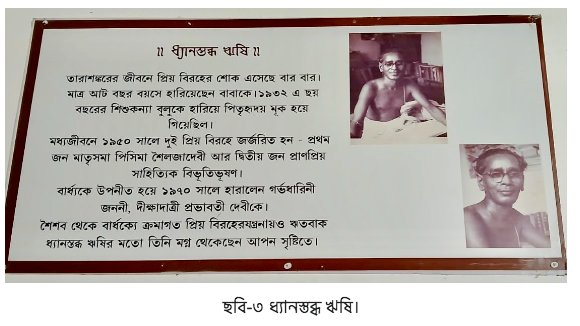
Tarashankar’s life was plagued by grief again and again from childhood to old age. Having lost her father at the age of eight, she lost her infant daughter Bulu at the age of six in 1932. In mid-life, in 1950, he was beset by two dear friends, the first one was Matrisma Pisima Shailjadevi, and the second one was the literary lover Vibhutibhushan. In 1970 he lost his pregnant mother Dikshadatri Prabhavati Devi after reaching old age. In this busy life, he remained engrossed in his creation like a meditative sage.
Adolescent Poetry:
Tarashankar’s first poem came out in the pen of the mother bird after the death of a baby bird in the garden of their living room at the age of eight only –
“The baby bird has died / the mother called back
I buried under the ground / We all weep together.”
After that, together with like-minded friends and relatives, Agamani published the first book of poetry. In 1926, Tripatra, the only poetry book written by him, was published.
In the field of literature:
Inspired by the writings of Premendra Mitra and Shailjananda, Tara Shankar, after his release in 1930, announced that he would serve the country through literary service. His first story Raskali has already been published in Kallol. The first novel Chaitali Vhirti published in 1931 was dedicated to Subhash Chandra Bose. The second novel Pashanpuri came out with his experience in prison. At that time artist Jamini Roy called, come from Lovepur to Calcutta. Tarashankar stepped into the metropolis of literary culture, a new struggle began.
Honors and Awards:
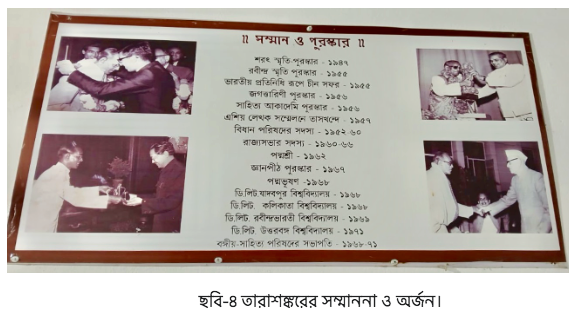
Krishna Kripalani forwarded Tara Shankar’s name to the Swedish Academy for the Nobel Prize in Literature in 1970 for two consecutive years. There the ‘Fable of Hansuli Banker’ was presented. Check out the rest of his achievements in the table below.

