
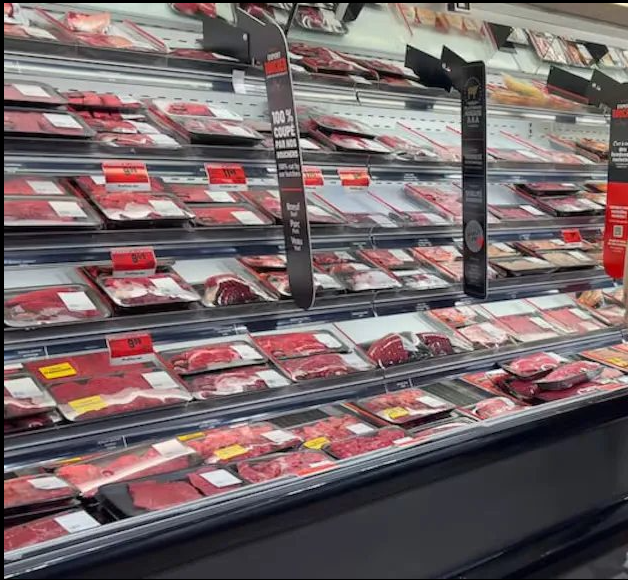
The conflict raging across the Middle East is no longer just a distant geopolitical crisis it is arriving at Canadian dinner tables. With Iran having effectively choked off the Strait of Hormuz, a crucial chokepoint through which roughly a fifth of global energy and nearly a third of the world’s fertilizer exports once flowed freely, experts warn that Canadians should brace for a prolonged and painful stretch of food price increases throughout 2026.
While forecasters had already anticipated grocery prices to climb between 4 and 6 percent this year, those figures are now looking optimistic. Sylvain Charlebois, senior director of the Agri-Food Analytics Lab at Dalhousie University, told reporters that his models now point to food inflation staying well above 6 percent for most of the year a trajectory that could cost the average family of four an extra $400 to $600 at the checkout, potentially rising further as the crisis deepens.
“Every 25 percent increase in oil prices above $55 a barrel adds roughly $150 to $200 to what a family of four spends on food,” Charlebois explained. With oil prices hovering around $100 a barrel, that math lands squarely and uncomfortably on Canadian household budgets.
The crisis, analysts say, is unfolding in two waves. The first and most immediate is the surge in energy costs driven by disrupted oil flows. The second potentially more damaging over time is the fertilizer crunch now bearing down on the global agricultural calendar at the worst possible moment. March and April represent peak fertilizer demand in the northern hemisphere, as farmers prepare fields for spring planting. The interruption to Gulf-region supplies, which account for substantial shares of nitrogenous and phosphate fertilizers, is arriving precisely when stocks need to be replenished.
Charlebois describes this as a potential “double-whammy down the road.” If spring planting is compromised, the downstream effect on food prices could be felt well into 2027, long after the crisis itself may have stabilized.
Canada is not without some insulation. Saskatchewan produces roughly a third of the world’s potash, a key fertilizer component, and many farmers who locked in fertilizer contracts before the disruption are shielded at least for now from the worst price spikes. But Al Mussell, research lead at Agri-Food Economic Systems, notes that fertilizer is not a single ingredient. “It’s a complete portfolio,” he said, and vulnerabilities elsewhere in that chain still expose Canada to price pressure.
Not all grocery items will feel the same sting. Michael von Massow, a food economics professor at the University of Guelph, says the heaviest near-term increases will hit products that are “heavily transportation-dependent” think imported fruits and vegetables, which arrive via long diesel-powered supply chains. Diesel prices themselves have surged 63 percent since late February, from roughly $2.59 per gallon to $4.22, compressing margins throughout the trucking and logistics industry and pushing those costs onto consumers.
Charlebois adds that refrigerated products dairy, meat, fresh produce, and seafood are among the most energy-intensive to store and transport, making them prime candidates for the steepest price increases. Bananas, pineapples, and coffee, which must travel thousands of kilometers before reaching a Canadian shelf, are also flagged as likely to lead the charge.
Sugar may also surprise shoppers. Brazil, a major sugar exporter, is diverting cane production toward ethanol to compensate for elevated fuel prices, while India the world’s second-largest sugar producer is contending with domestic energy shortages that are disrupting output.
On the other hand, more processed shelf-stable products like cereals and packaged snacks are expected to see only modest short-term increases, as transportation forms a smaller slice of their retail cost. And von Massow notes that goods shipped by sea face somewhat less exposure, since ocean freight is considerably more fuel-efficient than road transport.
The pain will not be distributed evenly across the country. Canada’s western provinces sit in a more favored position they produce and export their own fertilizer, largely to the United States, and have more direct access to domestic energy supplies. Eastern Canada, by contrast, depends more heavily on imported fertilizer and energy, leaving farmers and consumers alike more exposed to the disruptions emanating from the Gulf.
Historically, the parallels to the Russia-Ukraine War offer a sobering frame of reference. That conflict, which also rattled global oil and fertilizer markets, helped push Canada’s overall inflation rate to 8.1 percent year-over-year in June 2022, with food inflation alone approaching 12 percent. The current shock, Charlebois warns, carries a similar structure and similar risks.
“Even though we don’t buy wheat from Ukraine, global wheat prices became more expensive during that war,” he noted. The same logic applies today: when global commodity markets tighten, no major economy is fully insulated, regardless of its domestic production capacity.
Mussell offered a pragmatic if pointed summary for Canadian households: “For your higher-end luxury foods, you’ll need to cut back on the cognac and caviar. But for staples, I think Canada is pretty resilient.” The resilience, however, is not unconditional and for millions of Canadians already stretching budgets thin, even modest additional food costs can have real consequences.

