
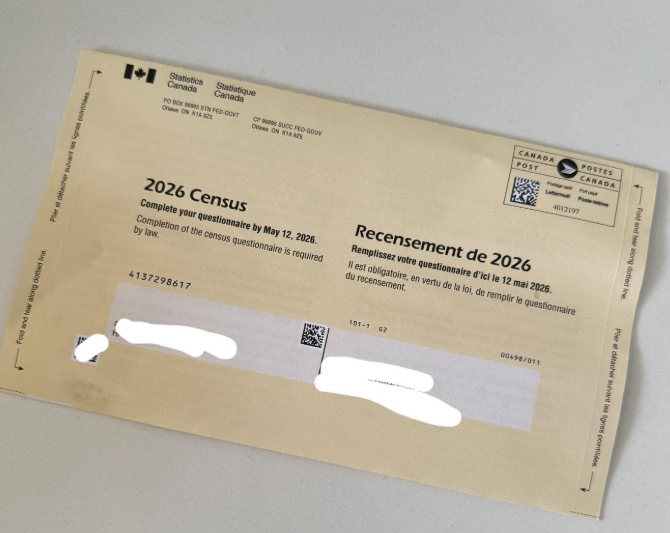
If you are one of the millions of Canadians who haven’t yet hit “submit” on your 2026 federal census questionnaire, expect a knock on your door or a ring on your phone very soon.
Statistics Canada announced that it is officially mobilizing thousands of census enumerators to conduct widespread, in-person and telephone follow-ups. The campaign aims to track down households that missed the initial mid-May response deadline.
While “millions of households” have already fulfilled their civic duty online, by mail, or over the phone, the federal agency is shifting to active field collection to ensure a complete national headcount.
“Census enumerators will begin contacting households from which a completed questionnaire has not yet been received,” StatCan stated. “In addition to phone follow-ups, they will also start going door to door in communities across Canada.”
A parallel push is also underway for the 2026 Census of Agriculture, which tracks data across every farming and agricultural operation in the country. For the agricultural sector, follow-ups will primarily be handled through targeted phone calls and emails.
The agency emphasized that the incoming wave of door-knocking isn’t purely punitive; it is also meant to provide a helping hand. The newly hired field staff are trained to assist residents who may find the paperwork confusing or are physically unable to fill it out independently.
With door-to-door scams always a concern for residents, the government is stressing security. Every official Statistics Canada employee is required to carry and present a valid government ID badge featuring their photo, name, and employee number.
Residents who want to be completely certain can instantly verify a worker’s identity by calling the official Census Help Line at 1-833-852-2026 or by checking the “Recognizing Census Communications” portal on the official StatCan website.
Under the federal Statistics Act, participating in the census is legally mandatory for all households. While officials note there isn’t a strict, single-day cutoff for late submissions, ignoring the government’s requests indefinitely carries real consequences. Anyone who ultimately refuses or neglects to complete the questionnaire can face a fine of up to $500, while actively obstructing a census worker can push penalties up to $1,000.
The data collected every five years serves as the foundational blueprint for how billions of dollars in public funds are distributed across provinces and municipalities, directly shaping future decisions on healthcare, public transit, schools, and infrastructure.
The questionnaire split remains the same as in previous years: Short-Form Census: Sent to 75% of Canadian households, focusing on core basics like age, birth date, gender, household relationships, spoken languages, and military service. Long-Form Census: Distributed randomly to the remaining 25% of the population. This version dives significantly deeper into income, cultural background, education, employment, and daily mobility.
Notably, the 2026 long-form version features a couple of historic updates. For the first time, it introduces a dedicated question tracking the baseline health status of Canadians, alongside a new question regarding sexual orientation aimed at filling long-standing demographic data gaps.
For those looking to avoid a knock on the door altogether, the online portal remains open at census.gc.ca.

