
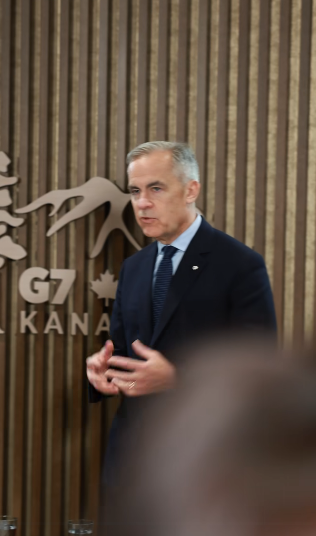
When Prime Minister Mark Carney and U.S. President Donald Trump sit down for their one-on-one meeting Monday morning in Kananaskis, they won’t just be shaking hands for the cameras. They’ll be carrying the weight of months of mounting tensions, unresolved trade disputes, and increasingly divergent worldviews — all of which are poised to shape the course of this year’s G7 summit.
Set against the scenic backdrop of Alberta’s Rockies, this gathering is anything but a vacation. The fact that Carney and Trump are meeting ahead of the formal G7 session speaks volumes. It’s not just protocol — it’s necessity. The bilateral relationship between Canada and the U.S., long seen as one of the most stable in the world, has been rocked by a barrage of American tariffs that have frustrated Canadian businesses and policymakers alike. Despite a face-to-face in Washington back in May, no significant breakthrough has emerged, and the upcoming talks offer little promise of an easy fix.
Carney’s packed schedule on June 15 suggests he is playing the role of both diplomat and dealmaker. Meeting with British Prime Minister Keir Starmer, Australian PM Anthony Albanese, and South African President Cyril Ramaphosa in quick succession before his evening with Germany’s Friedrich Merz, Carney appears to be building a coalition — or at the very least, testing the waters for consensus ahead of the main event. These meetings aren’t just formalities; they are strategic positioning in a summit where common ground may be in short supply.
In their morning chat in Ottawa, Carney and Starmer emphasized the importance of a rules-based international order and free trade — a clear nod to the post-WWII institutions that Trump has consistently challenged. It’s no secret that the U.S. president’s “America First” policy rubs many G7 leaders the wrong way, especially when it manifests in sudden tariffs and withdrawal from multilateral commitments. For Carney, reinforcing the value of global cooperation is not just a diplomatic stance — it’s a rebuttal to Trump’s unpredictable style.
Meanwhile, the Canadian agenda for the summit is ambitious but telling. Fighting foreign interference, enhancing AI and energy security, and unlocking economic growth through private investment are not only priorities — they’re defensive maneuvers in an increasingly fragmented world. It’s hard not to see the focus on “critical mineral supply chains” as a quiet counter to China’s growing dominance, or the emphasis on wildfires as a veiled critique of slow climate action from key allies.
The return to Kananaskis, where the G8 last met in 2002 before Russia’s suspension, brings with it a sense of history — and irony. Back then, there was talk of expanding democratic cooperation. Today, the G7 feels like it’s scrambling to hold the line amid rising authoritarianism, economic nationalism, and a changing geopolitical order. Russia’s ongoing war in Ukraine, tensions in the Indo-Pacific, and the Middle East crisis will all be front and center — and yet the tone of the summit may very well be set by the chemistry (or lack thereof) between Carney and Trump.
As global crises pile up, the world needs the G7 to function not as a club of rich nations but as a compass for international cooperation. Whether Carney and Trump can rise above their differences and find common purpose could determine whether this summit delivers more than photo ops.
Let’s hope Monday morning brings more than just polite conversation — because the stakes are too high for anything less.

