
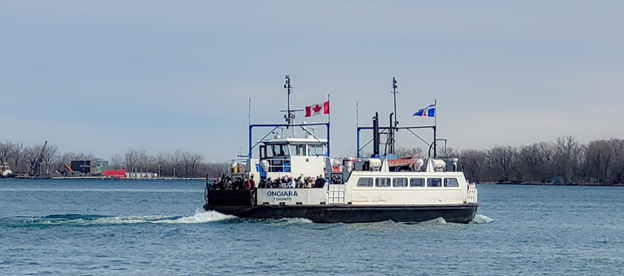
Canada’s Transportation Safety Board (TSB) has released the final report into the August 2022 ferry crash at Toronto’s Jack Layton Ferry Terminal, concluding that multiple safety deficiencies and operational pressures played a key role in the incident that injured several passengers, including young children.
The crash happened on August 20, 2022, when the Sam McBride ferry was completing a trip from Centre Island to the mainland. At the time, the vessel was carrying 910 passengers and six crew members. Shortly after 5 p.m., as the ferry was docking, it struck the terminal with significant force.
The sudden impact caused around 20 passengers many of whom were standing on or near the stairways to be thrown forward. While most injuries were minor, five people required hospital treatment. Among them was a three-year-old boy who suffered facial injuries and needed stitches.
“I just saw his body fly,” his mother, Jasmine Mallory, told reporter at the time. “There was blood all over his face. It was terrifying.”
According to the TSB’s findings, the ferry was approaching the dock faster than it had earlier in the day. Investigators determined that the vessel had already completed eight trips, many at full capacity, and was running behind schedule.
The report states that these “operational pressures” likely influenced how the ferry was handled during docking. Compounding the issue, only one of the ferry’s two propellers was operating as it neared the terminal.
“Given the vessel’s speed and distance from the dock, one propeller alone was not sufficient to stop the ferry,” the TSB noted. A mechanical failure was ruled out after inspections confirmed both engines and control systems were functioning properly.
The investigation also highlighted a significant procedural gap: the City of Toronto did not have written guidelines defining safe docking speeds or standardized berthing practices.
“Masters were left to operate in the way that they deemed appropriate,” the report stated, adding that without formal procedures, decisions may have been influenced by time pressure rather than safety considerations.
The TSB identified several broader safety concerns related to passenger management and emergency preparedness:
Crew Training Deficiencies: Crew members were not required to undergo emergency passenger management training. As a result, the TSB warned that in a serious emergency away from shore, the crew may not have been able to respond effectively. Recommendation: Transport Canada should require all passenger vessel crews, including those operating in sheltered waters, to complete passenger safety management training.
Unrealistic Evacuation Plans: The ferry’s evacuation procedures assumed that six crew members could safely manage more than 900 passengers during an emergency, while handling multiple tasks at once. Recommendation: Transport Canada should establish a formal process to validate and approve evacuation procedures for passenger vessels.
Inadequate Passenger Counting: There was no requirement to separately track the number of children and infants on short voyages. Passenger counts on the Sam McBride were estimated using a handheld tally counter, without distinguishing vulnerable passengers. Recommendation: Transport Canada should require accurate passenger counts on all voyages, including separate counts for children and infants.
The TSB noted that several improvements have already been implemented since the incident. Crew levels on the Sam McBride have been increased from six to 13, safety briefings have been updated, new signage has been installed, and passengers are now warned not to stand on stairs while the ferry is moving.
In a statement released Monday, the City of Toronto said it fully supports the TSB’s findings and recommendations.
“The report highlights important actions to increase safety in the operation of Toronto’s ferries,” a city spokesperson said. “The City has already implemented many of these procedures and continues to enhance ferry safety standards.”
The city added that it has formalized safety protocols, expanded staff training, increased the number of life jackets on board, improved bridge deck lighting, and enhanced pre-departure safety briefings measures that remain in place today.
The TSB hopes its recommendations will help prevent similar incidents on passenger ferries across Canada in the future.

