
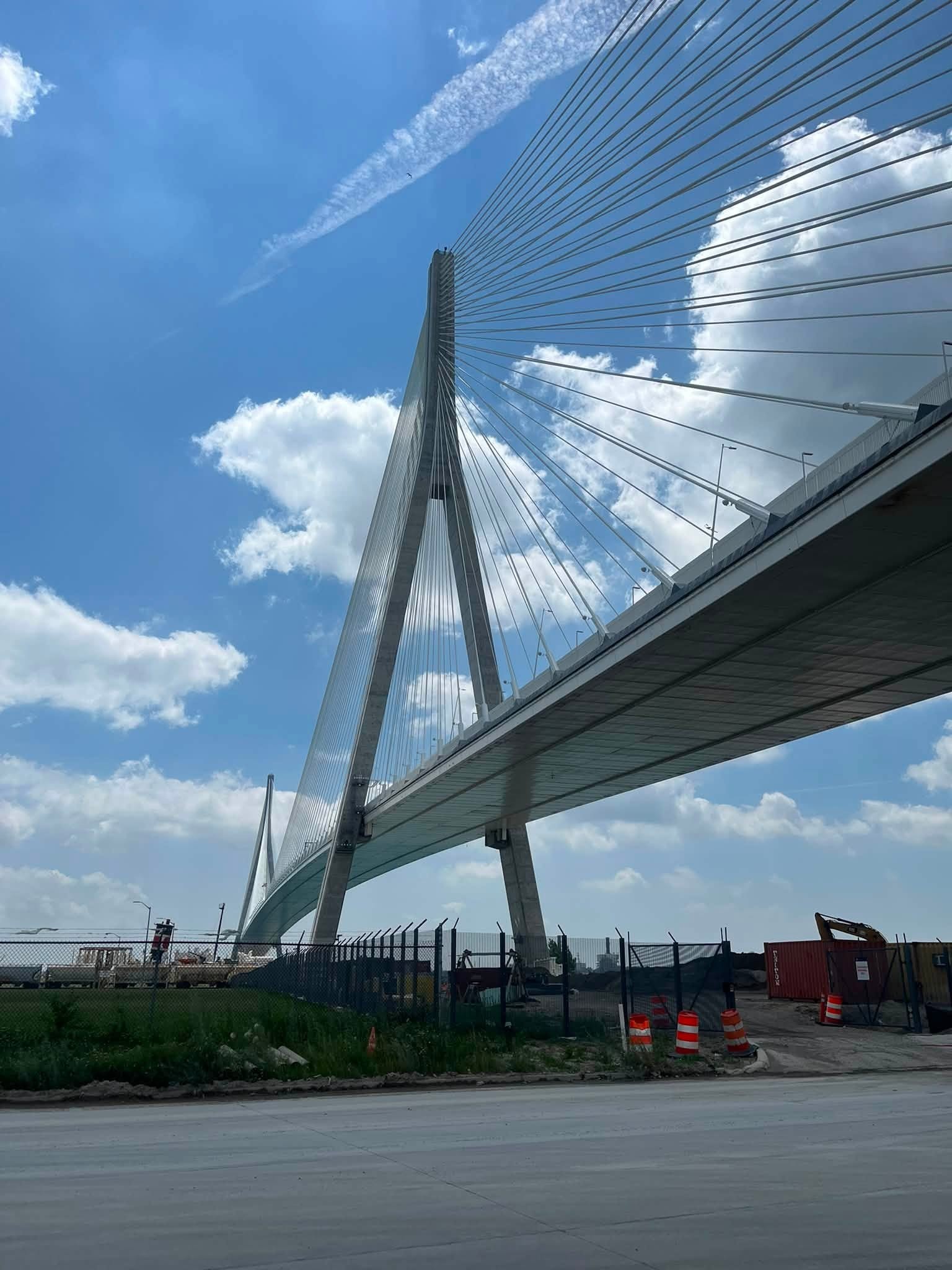
Prime Minister Mark Carney fielded pointed questions from reporters on July 16 over a reworked toll-sharing arrangement with the United States for the Gordie Howe International Bridge, a deal that has drawn fire from opposition MPs and left several key details unexplained.
Canada financed the entire $6.4-billion construction cost of the bridge on its own. In return, a 2012 agreement guaranteed Ottawa the full 36 years of toll income until that investment was paid back in full, with revenue only then being shared with Michigan.
That arrangement changed after Washington held up the bridge’s opening last month, objecting to the terms it had signed onto years earlier. A fresh agreement, struck on July 10, cleared the way for the crossing to open by the end of July but on different financial terms.
Carney told reporters in London, Ontario, that Canada will now share “net revenues … after operational costs” with the U.S. for a 15-year stretch. He described operational costs as covering items like staffing, maintenance and snow removal.
Despite the shift toward earlier revenue-sharing, Carney maintained that Canada’s debt still comes first. “Any sharing of the toll revenue won’t happen until all of the debt is repaid,” he said, adding that net revenues are actually expected to run negative in the bridge’s early years as traffic volumes build up.
“We expect that after those costs, for the first few years, net revenues will be modest. In fact, we expect them to be negative as traffic ramps up,” Carney said.
Pressed for further specifics on the agreement, Carney argued that Canada and the U.S. now have matching incentives, since regional economic growth on the Michigan side of the border ultimately strengthens bridge usage overall.
He also pushed back against criticism that Michigan is getting a cut of net revenue sooner than the original deal allowed, framing the U.S. share as money that will flow straight back into the local economy. “All of the portions that go to the U.S. government will be reinvested in economic development, regional economic development in the area, the U.S. side of the area, obviously, which is pro-cyclical,” he said, adding that the reinvestment should, in his view, generate more traffic, higher revenue and further investment in a self-reinforcing cycle.
The revised deal has not gone over well with opposition Conservatives. Six Conservative MPs wrote to Canada-U.S. Trade Minister Dominic LeBlanc on July 12, calling it a “terrible deal for Canada” given that Canadian taxpayers covered the entire construction bill on the understanding they would collect all toll revenue until fully repaid.
Their letter posed several unanswered questions: whether the U.S. now holds any new authority over toll rates, whether the deal altered who owns or governs the bridge, whether any revenue would flow into the U.S. economic development fund before Canada recoups its full costs, and what, if anything, Canada received in exchange for agreeing to the new terms.
Shuv Majumdar, the Conservative Party’s critic for Canada-U.S. relations, said on July 16 that Ottawa had made a “concession” in reworking the deal and called for its full details to be made public.
U.S. Ambassador to Canada Pete Hoekstra has said the renegotiation was prompted by the bridge project running over budget and behind schedule, which he said undercut the assumptions behind the original 2012 arrangement. He has also contended that the new bridge risks simply pulling traffic and revenue away from the existing, privately run Ambassador Bridge rather than creating new cross-border traffic altogether.
With the bridge slated to open before the end of July, pressure is mounting on the federal government to release the full text of the agreement and clarify exactly how tolls, costs and governance will be handled going forward.

