
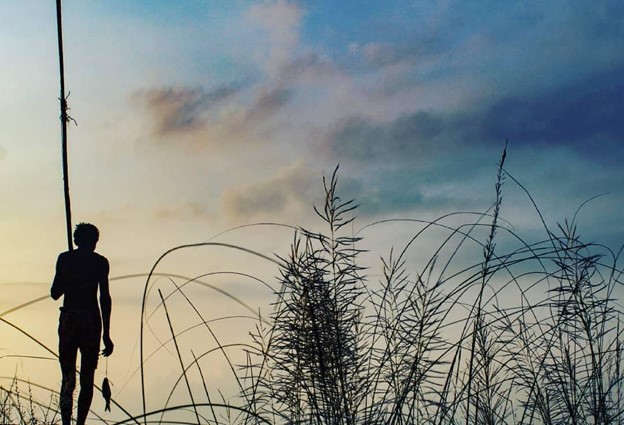
As soon as I woke up, I saw it was raining heavily outside. Of course, with the doors and windows of the room closed, I couldn’t hear the sound of the rain very well. I took out the umbrella from under the bench and found it was broken. Then I remembered that the umbrella had broken during the monsoon last year, and I hadn’t gotten around to fixing it. No one else in the entire room had an umbrella. I went to Tipu bhai’s room next door, but I didn’t find an umbrella there either.
I have to go to the hospital today, but I won’t be able to leave the hall in this kind of rain. About an hour has passed, and the rain is not stopping at all. Every time the rain stops for two minutes, it starts again cats and dogs.
Finally, I came out of the hall in the rain. The downpour has subsided a bit, but there’s still a drizzle. I immediately hailed a rickshaw and said, “To Marine Clinic.” Mira’s mother has been admitted to this clinic for the past eleven days. I’ve visited her once before, so this will be my second visit.
I met Mira at a university function. Mira sang, and I recited poetry. When Mira started singing, the audience was packed. As soon as the announcement was made over the mic, “Now, we have a poetry recitation for you…”, I saw the audience start to clear out. Some went to have tea and cigarettes, while others had been sitting for so long that their hands and feet had gone numb, so they went outside to relieve that numbness. Of the few people who remained, some took out their phones and focused on their phone screens. Still, I started reciting the poem. Mira looked at me the entire time I was reciting. I recited two poems by the poet Abul Hasan. After getting off the stage, Mira came and said, “Abul Hasan is my favorite poet.” That’s how I met Mira.
Then there were those times in the canteen, sipping tea, listening to Mira’s voice as she sang songs about the rainy season while we were getting drenched. Walking side by side, our love grew over cups of tea, and then it blossomed into affection. Deep within my heart, there resides a girl like a delicate lotus, untouched by the city’s concrete, whose touch can erase all my day’s sorrows.
Mira is no longer just my girlfriend; we’re married. Although, apart from our two mutual friends, Tipu and Mira’s two girlfriends, no one knows about our marriage. Mira is very beautiful, and when such girls attend weddings, their relatives, who often work in government jobs, start setting traps for them. Whenever Mira went to a wedding, a few marriage proposals would come to our house.
Mira decided then that we would get married. Mira said, “I can’t spend my life in luxury. I’ll spend a lifetime close to love.”
Our wedding took place at the registrar’s office with only five people present. After the wedding, we wandered around the entire city that day. I couldn’t give Mira much; just a garland of night-flowering jasmine and a pair of one-hundred and twenty-taka earrings. The sari Mira was wearing was her mother’s.
Mira’s mother knows about our marriage, but Mira’s father doesn’t know yet. Mira’s father can’t stand me; there’s an arrogance in his eyes. The last time I went to the clinic to see Mira’s mother, Mira’s father first looked at my shoes, then at my clothes in a way that seemed like he was checking how expensive my clothes were. There’s always an arrogant look in his eyes. He can’t stand me alongside Mira.
I sat beside Mira’s mother’s bed. The hospital wasn’t like a typical hospital. It didn’t feel like a place where sick people stayed. Hospitals usually have a smell, but there was nothing like that here. There was an air conditioner running in Mira’s mother’s room. Luckily, Mira was present. She was feeding her mother when I arrived.
I didn’t know what to say to a sick person. Should I ask, “How are you?” Mira’s mother would probably say, “I’m fine.” If someone was truly fine, why would they be lying in a clinic bed? I asked Mira’s mother, “How are you feeling now?” She said she was much better, but her spine ached at night. Mira said the doctor had told her she could go home in two days. I watched quietly as a girl so carefully fed her mother. Mira’s face was covered in pimples, and she looked so miserable. It made sense. She came here several times a day, managed the household, cooked, and cared for her mother. The strain was evident on her face; dark circles under her eyes. Looking at Mira, it seemed like she hadn’t combed her hair in days. Mira’s mother used to comb Mira’s hair, but now she was sick, or maybe Mira didn’t have time to even touch a comb. After running around all day, fatigue would set in, and Mira would sleep, or maybe she couldn’t sleep. At night, when Mira’s mother woke up with pain, she couldn’t sleep either. Looking at Mira’s face, I felt a surge of compassion.
A little later, Mira’s younger aunt arrived from the village. I thought I would take Mira out today. It had been a long time since we had sat and talked. Mira said, “You go and explain the medicines to my aunt, and then I’ll come after I’ve showered.” I left the clinic and went straight to Isabella Market. I bought a comb and put it in my pocket. I went to the river. I called Mira and told her to come to the riverbank.
An hour later, Mira arrived wearing her mother’s green sari. She had worn this sari twice before. Mira looked like a banana leaf now. Do people ever become like banana leaves? The way moonlight falls on a banana leaf on a full moon night and makes it look so smooth, that’s how Mira looked.
Mira said, “Let’s take a boat.” I rented one. The boat was on the Maj River. The rain had stopped, but the sky was still cloudy. I told Mira, “Sit in front of me.” I untied Mira’s braid and took out a comb from my pocket. Mira smiled. She said, “It’s been so long since I’ve had my hair combed properly.” As I combed her hair, it felt as if, as Jibanananda Das said, a strange darkness had descended upon the world.
Mira said, “You know, I think I love you for these small reasons. Like when you pick wildflowers and keep them in your pocket for me. Or how you noticed that I hadn’t had my hair combed in a long time, something most people wouldn’t care about. Who else would love me like that?” She continued, “Someday, we’ll have a little house. In the evenings, I’ll sit on the rooftop, and you’ll comb my hair, won’t you?” I said, “Yes, I will.” Mira replied, “Let’s live not just on oxygen, but on love too, for as long as we live.” She started singing, “Did you bind the flowers of the Shapla with thread, or is it your face…”
Three years later, we had our own little house. Mira’s father had grown somewhat fond of me. We lived in a room in the attic, with Mira’s two birds and a few flowerpots on the balcony. A bookshelf, a bed, Mira, and I – that was our small world. Our room was small, but it was filled with love, care, and affection for each other. On Fridays, since I had the day off, I would be home. In the soft afternoon sunlight, Mira would let her hair down, and we’d sit on the roof as I combed her hair.

