
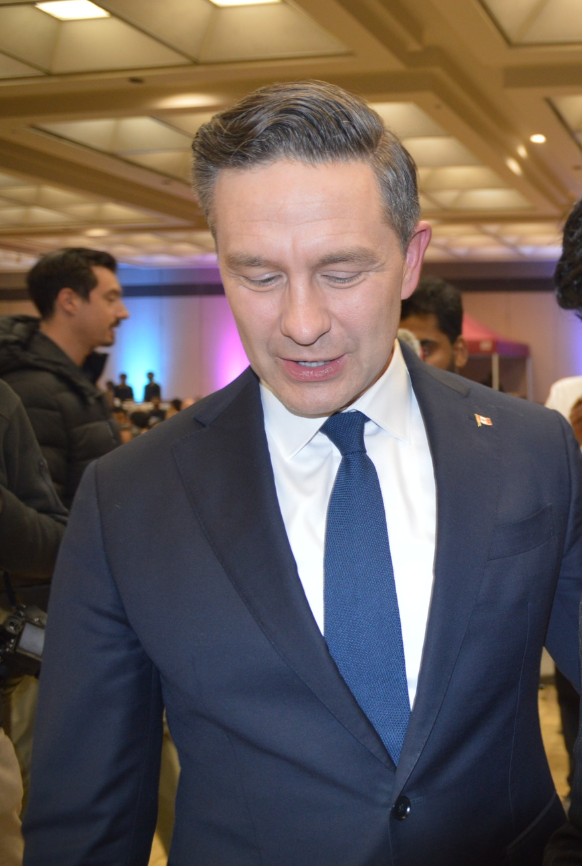
The Conservative Party of Canada is preparing for a pivotal internal decision as delegates gather in Calgary later this month to determine whether Pierre Poilievre should continue as party leader.
The party’s national convention will take place in Alberta’s largest city from Jan. 29 to 31, where a formal leadership review will be held in accordance with the party’s constitution. Delegates will vote by secret ballot on whether Poilievre should remain at the helm following the Conservatives’ loss in the most recent federal election.
Under party rules, if a leader does not step aside after an election defeat, a leadership review is mandatory at the next national convention. Should more than half of voting delegates choose change, the Conservative caucus would appoint an interim leader and launch a new leadership race.
In addition to the delegate vote, Conservative MPs also have access to another mechanism under the federal Reform Act, which outlines how caucus members can initiate a leadership review internally. That process requires a specified number of MPs to request a vote, followed by majority support within caucus.
The Conservatives are currently the only major federal party to have adopted the Reform Act provisions. The Liberals and New Democrats have declined to do so since the legislation was introduced in 2015, limiting their MPs’ ability to formally challenge party leadership.
The Conservative caucus previously used the Reform Act in February 2022 to remove former leader Erin O’Toole, when 73 of 118 MPs voted in favour of his ouster.
Poilievre became Conservative leader in September 2022 and presided over a prolonged period in which his party led national polls. That advantage narrowed dramatically after Justin Trudeau resigned and Mark Carney won the Liberal leadership, sparking a sharp rebound in Liberal support.
External pressures, including trade tensions driven by U.S. President Donald Trump and the collapse of support for the NDP, further reshaped the political landscape.
In the subsequent federal election, the Liberal Party of Canada secured 169 seats just shy of a majority while the Conservatives won 144. The Bloc Québécois captured 22 seats, the New Democratic Party fell to seven, and the Green Party of Canada won one.
Despite gaining 24 additional seats overall, Poilievre suffered a personal setback by losing his long-held Carleton riding to Liberal candidate Bruce Fanjoy, ending nearly two decades in Parliament. Poilievre later suggested his defeat stemmed from his proposals to shrink the federal public service an unpopular message in a riding with a high concentration of government workers.
During Poilievre’s absence from the House of Commons, former Conservative leader Andrew Scheer served as Opposition leader. Poilievre returned to Parliament following an August 2025 byelection in Alberta’s Battle River–Crowfoot riding, winning more than 80 percent of the vote after MP Damien Kurek resigned his seat to allow Poilievre to run.
The party has since confirmed that Kurek will seek re-election in Battle River–Crowfoot in the next general election, while Poilievre will contest a different riding.
Recent polling suggests Poilievre remains firmly backed by Conservative supporters, though enthusiasm has softened. A Jan. 26 survey from Abacus Data found that 76 percent of Conservative voters want him to remain leader, while 14 percent favour his removal. That compares with 91 percent support recorded in late 2023, when Liberal fortunes were at a low point.
At the national level, the contrast is starker. An Angus Reid poll released the same day showed Carney enjoying a 60 percent positive rating among Canadians his highest since becoming prime minister while Poilievre’s favourability stood at 36 percent, with a majority expressing negative views.
Compounding the pressure, two Conservative MPs Chris d’Entremont and Michael Ma have crossed the floor to join the Liberals in recent months. Another MP, Matt Jeneroux, has announced plans to resign this spring and has frequently broken ranks in recent votes.
Despite the challenges, Poilievre has framed the leadership review as a democratic exercise for party members. In a recent interview, he said the decision ultimately belongs to grassroots supporters across the country.
“They will decide with their democratic vote,” Poilievre said, emphasizing that he remains committed to advocating for working Canadians and small business owners.
As delegates arrive in Calgary, the vote will offer the clearest signal yet on whether the Conservative Party believes Poilievre remains the right leader to take on a resurgent Liberal government or whether a new chapter is about to begin.

