
September 30th marks Canada’s National Day for Truth and Reconciliation, a day dedicated to honoring the Indigenous children who never returned from residential schools, as well as those who survived and their communities. The day also encourages Canadians to wear orange shirts in solidarity with survivors.
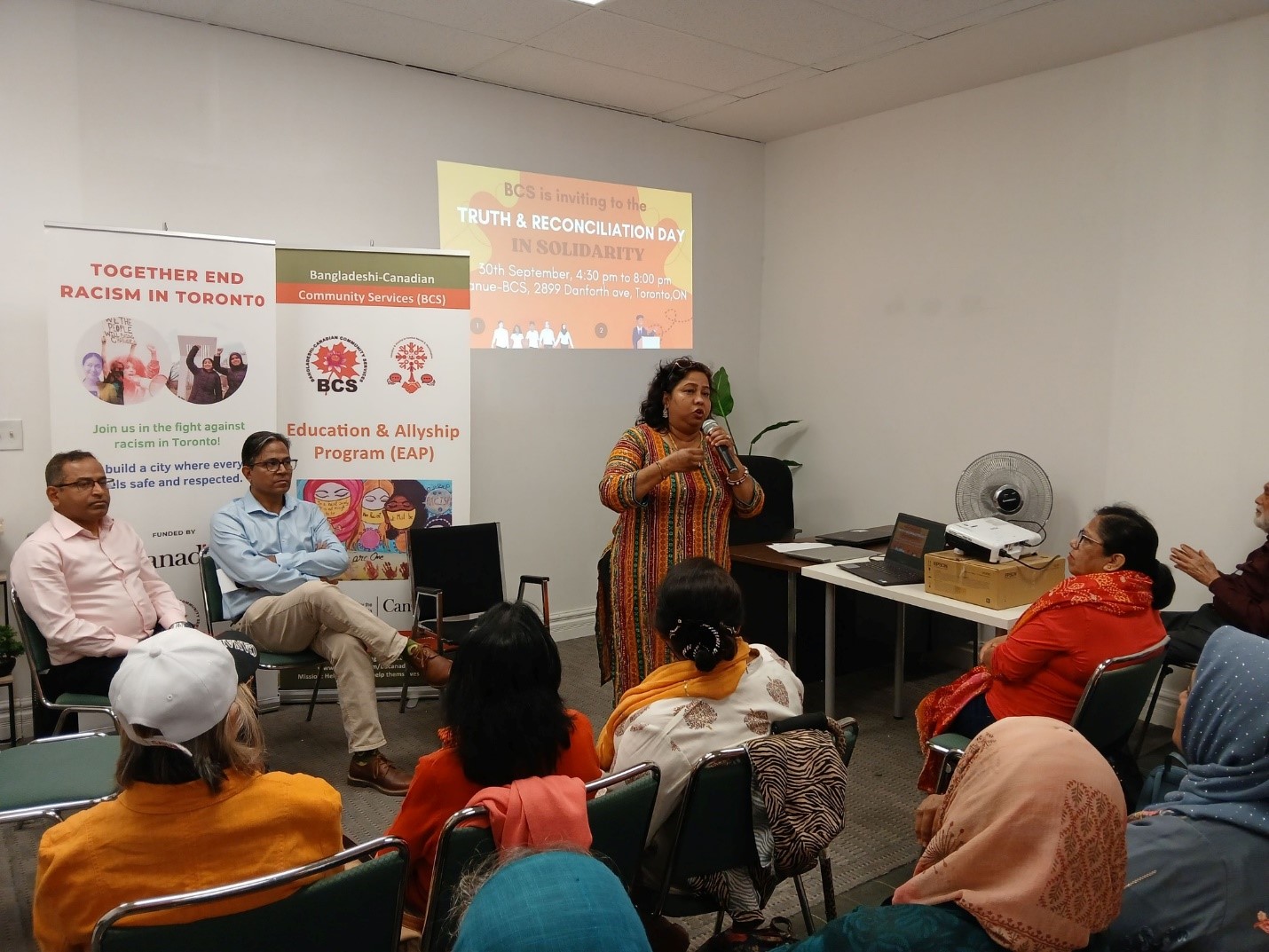
On September 30, 2024, over a hundred people gathered at the BCS office in Danforth to commemorate this day. The event, organized by BCS’s Education and Allyship Program (EAP), featured several prominent speakers from various organizations, including Afroza Begum from the Bangladesh Center and Community Services (BCCS), Mostak Ahmed from the Canadian Center for Information and Knowledge (CCIK), Enamul Haque from Progressive Action for Community Empowerment (PACE), Sultana Jahangir and Nazli Sultana from the South Asian Women’s Rights Organization (SAWRO), and Nazli Sultana from the South Riverdale Community Health Centre (SRCHC). Students from a Toronto university and high school – Afia, Samiya, Shreya, and Sonali – were also present. Most attendees wore orange to honor the day.
Dr. Nasima Akhtar, the Executive Director of BCS, welcomed the event. Dr. Mahbub Hasan expressed gratitude for the event. The speakers present discussed the importance of the day from various perspectives and shed light on the various aspects of the atrocities committed against the Indigenous people of Canada. Afroza Begum (BCCS) spoke about Canada’s Truth and Reconciliation Day and the history and significance of Orange Day. She explained how the Indigenous people of Canada were persecuted, resulting in the deaths of countless Indigenous children. The surviving Indigenous children suffered from trauma. They were not treated fairly in the name of doing good. These children were victims of racism across Canada.
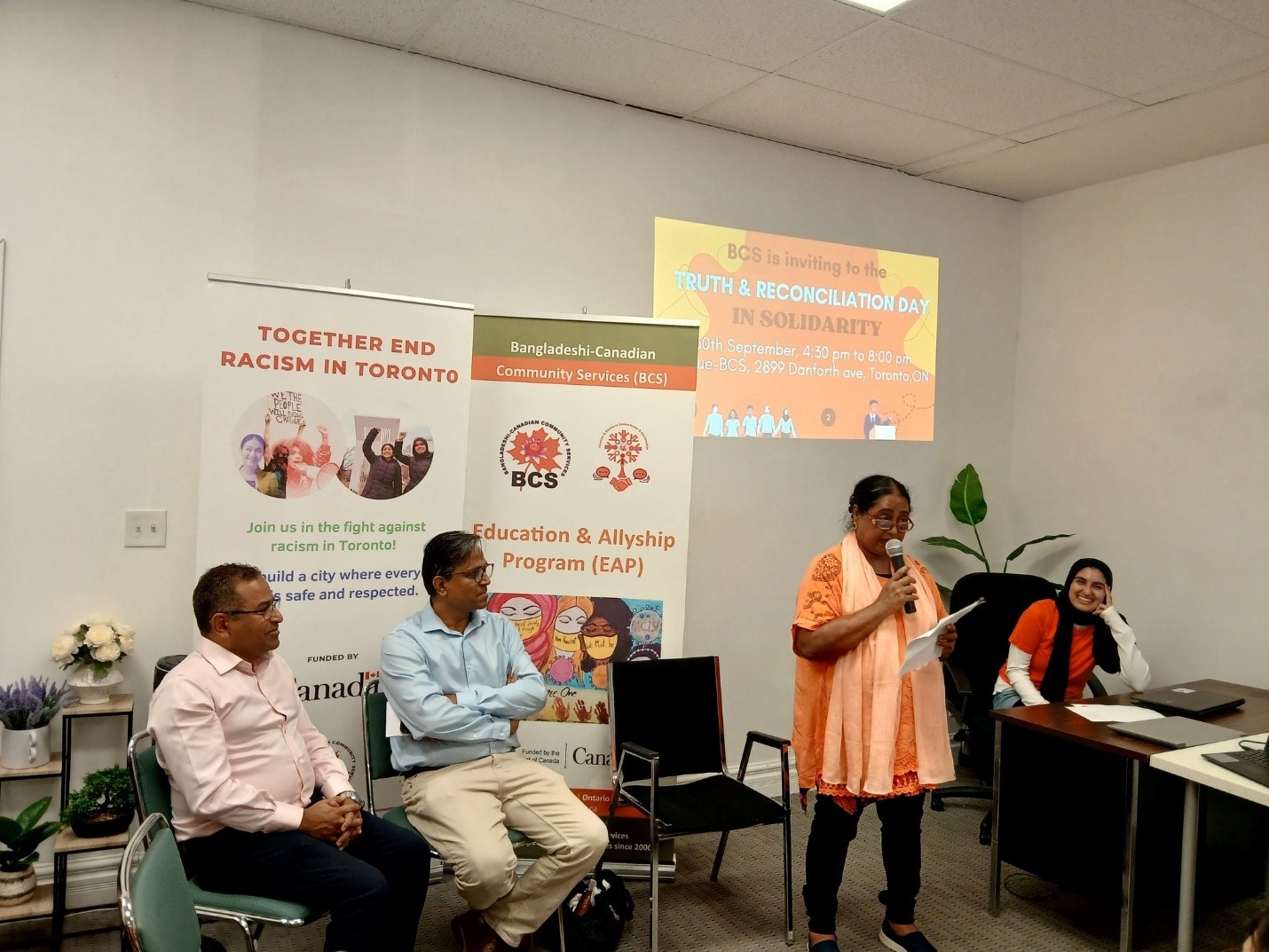
Afiya, Samiya, Shreya, and Sonali, students from the University of Toronto and high school, presented the inhumane incidents that happened to the Indigenous people in the past. The students said, “We need to understand, to realize, what reconciliation means to you?” How in 2021, an attempt was made again to reconcile the Indigenous people with other Canadians. Afiya, Samiya, Shreya, and Sonali’s speeches detailed the story of the atrocities committed against the Indigenous people of Canada for nearly 100 years. The Canadian government established 130 residential boarding schools for Indigenous children. The schools were operational from 1874 to 1996. The powerful Christian churches of that time worked with the European Canadian government. During this time, they forcibly took Indigenous children from their homes. During this period, about 150,000 First Nations, Métis, and Inuit children were sent to residential schools in Canada. At least 6,000 of these students died while attending school. Although the schools tried to provide some education, there was very little funding for the schools. As a result, children did not get good food. They did not receive medical treatment. Many of these children were physically and sexually abused by teachers. Thousands of children died from malnutrition, neglect, and disease. In these schools, attempts were made to mold Indigenous children into European-Christian identities instead of their Indigenous identities. Their emotions, feelings, and their culture had no value to the Canadian government. Then, after 2021, unmarked mass graves began to be found around the closed church schools. The remains of hundreds of Indigenous children were recovered from these graves.
The students further mentioned how Orange Shirt Day came into being. Inspired by the real-life story of Phyllis Webstad in 2013, a special day was initiated. On her first day at a residential school as a child, her newly bought orange shirt was taken away from her by the school authorities. The orange shirt is a symbolic representation of the emotions and culture of the Indigenous people. This incident represents the taking away of the identity and culture of these Indigenous people, which was a consistent and deliberate occurrence within the Canadian residential school system. Children were separated from their families, language, and culture for months, even years. Children were separated from their families, their culture was changed, their traditions were altered, and their racial identity was changed. These are actually changes in culture. The Canadian National Truth and Reconciliation Commission condemned this as ‘cultural genocide’.
Speakers further said that these children suffered from national trauma. It was a big mistake. Later, a commission was formed to give them a dignified life. They admit their mistakes. Between 2007 and 2015, the commission surveyed 7 regions, individuals, and families, and kept records in Manitoba. They need to be given public education. The other side of the wall must be broken. It needs to be an integrated project for them. Counseling alone will not be enough. They need to be given a dignified life so that they can stand tall.
Mostak Ahmed of the Canadian Centre for Information and Knowledge (CCIK) said that the Indigenous people were forcibly taught against their will. He said, “We are singing our songs. We should also listen to the songs of the Indigenous people. It would have been good if the Indigenous people could have been involved in today’s program.” He also spoke about the importance of Orange Day.
Enamul Haque, director of Progressive Action for Community Empowerment (PACE), said the churches are largely responsible for the suffering of the indigenous people. Because at that time the ruling power was basically under the church. The Pope apologized. This is not the only solution for healing. The truth must be accepted. Stand by them. Reconciliation is required among themselves. We must speak and act with respect for each other.
It should be noted that the Truth and Reconciliation Commission was formed in 2008. The Truth and Reconciliation Commission ran from 2008 to 2015. This resulted in the sharing of stories and experiences by victims or legacies of the residential school policy, either directly or indirectly. Their aim was to revive and preserve the indigenous language, culture and traditions “The Canadian government has taken far too long to acknowledge its history, to accept responsibility for the genocide it committed and to acknowledge the collective loss of our nation through residential schools,” said Indigenous leader Gary Feschuk. “The Canadian government should not just acknowledge the loss, it should walk with us.” , should help undo. Canada’s Truth and Reconciliation Commission reported in 2015 that Aboriginal children were forcibly separated from their families and homes. Inhumane torture was done. They were subjected to ‘cultural genocide’ in residential schools in Canada
In the name of assimilation, the history of state deprivation of Canadian indigenous peoples, namely First Nations, Inuit and Métis, is long. From the late eighteenth century, the Canadian government and European-Canadians began to encourage the process of assimilation of Aboriginal people into ‘native’ Canadian culture. One initiative after another was taken to completely assimilate the tribals into the ‘mainstream’ culture. Various laws like the Gradual Civilization Act, the Indian Act etc. were made for this, the main ideas of which were European ideals of Christianity, settled life, agriculture and education. The process of conversion of the aborigines started when the first missionaries came to Canada in 1600 AD. Various restrictions were imposed on those who would not convert.
The Truth and Reconciliation Commission (TRC) was established as part of the 2008 Indian Residential School Settlement Agreement. The commission was tasked with investigating and documenting the history and ongoing effects of Canada’s residential school system. The commission issued a final report in 2015, which included 94 recommendations for reconciliation. This 94 Call to Action is an action plan to advance reconciliation between Canada’s Aboriginal peoples and European settlers in Canada. Supporting indigenous survivors and addressing the injustices that indigenous peoples have faced and continue to face. At the end of the program Dr. Kazi Shafayetul Islam Turya, senior program coordinator of BCS spoke about various aspects of health at the health break. Coordinator of Education and Allyship Program (EAP) project Janatul Islam gave the concluding speech of the program.
Orange Shirt Day and the National Day of Truth and Reconciliation are a way to show your support and solidarity for indigenous peoples. This day is not just a celebration but an opportunity to learn from past mistakes and build a better community. This day is commemorated by people of all ethnicities in Canada. Wearing orange shirts is an attempt by ordinary people of Canada to express sympathy towards indigenous peoples. This day teaches us to be friends with people of all walks of life, not just with the tribals. This day reminds us to forget the differences between people. Stand by people with all the love in your heart. Through this program we learn how to forget racism and stand by people like a sympathetic human being like a friend.
Education and Allyship Program (EAP) project of BCS organized this event of ‘Truth and Reconciliation’ Day.
Scarborough, Canada

