
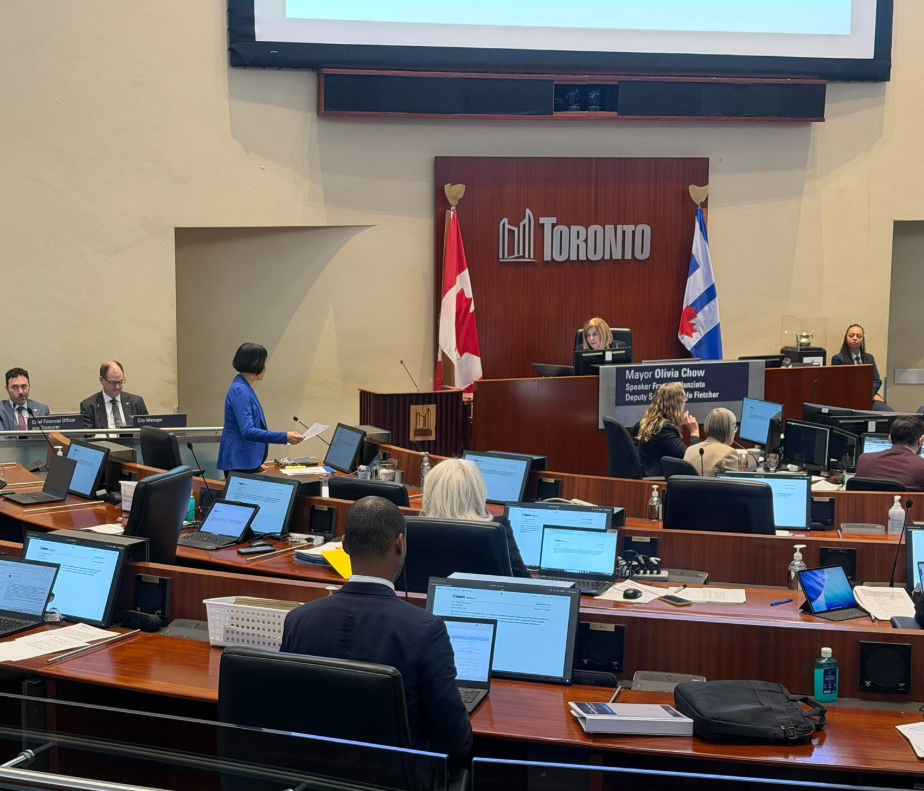
Toronto City Council has approved an additional $238,249 for its rain barrel subsidy program after overwhelming public demand drained the original funding in less than a day.
The council voted on June 24 and 25 to increase the 2026 Operating Budget for Environment, Climate and Forestry, with the extra money fully recovered from Toronto Water. To keep costs predictable across the program’s rollout, an amendment was added capping purchases at one rain barrel per eligible address.
The move came roughly three weeks after Mayor Olivia Chow urged council to expand the program, pointing to the speed at which the initial stock disappeared.
“Rain barrels reduce stormwater runoff and reduce water consumption, particularly in the summer, and this program makes them affordable for homeowners,” Chow said. She noted that the initial allocation sold out in just nine hours and that her office had since fielded a wave of inquiries from residents hoping to get in on the next round.
Chow framed the program as one piece of a broader affordability push embedded in the city’s 2026 budget, aimed at helping homeowners cut costs and boost energy efficiency.
The roots of the program go back to the fall of last year. On October 8 and 9, 2025, City Council agreed to launch a one-year pilot offering rain barrels and downspout diverters to Toronto residents at subsidized rates, so homeowners could collect stormwater on their own property.
That decision itself built on a proposal tabled on September 12, 2025, which outlined a longer three-year pilot running from 2026 to 2029 with a projected total cost of $2.55 million. The proposal was driven in part by a troubling pattern in the city’s recent weather history.
“In the last 20 years, Toronto has seen at least four intense storms that have exceeded the 100-year storm, which historically has a one percent chance of occurring in any given year,” wrote James Nowlan, executive director of Environment, Climate and Forestry, in the September proposal. “These storms have caused widespread flooding and power outages and have disrupted transportation, city services, and people’s daily lives.”
The program was designed not just as a flood mitigation measure but also as a way to reduce pollutant runoff into waterways and help homeowners swap out potable water for collected rainwater when watering gardens or washing outdoor surfaces.
The subsidy is open to all Toronto property owners, identifiable by a postal code beginning with the letter “M.” Eligible residents can purchase one rain barrel for $8.95 plus tax, and one downspout diverter for just $1.00 plus tax, with free delivery straight to their door.
The city notes that rain barrels work best on properties that already have a roof, eavestrough, and accessible downspout making low-rise homes, garages, and sheds good candidates. Properties without downspouts or adequate drainage may not be well-suited for the equipment.
City Council has also asked Nowlan’s office to file a full effectiveness report by the end of 2028, along with any recommendations for refining or expanding the initiative before the pilot period wraps up.

