
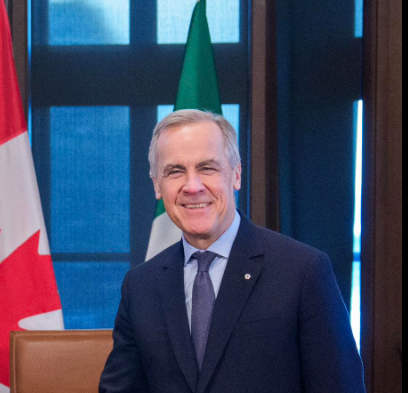
Prime Minister Mark Carney has made it clear that Canada has no plans to pursue a free trade agreement with China, pushing back against growing tensions with the United States after President Donald Trump warned of sweeping tariffs on Canadian goods.
Speaking to reporters ahead of a Liberal caucus meeting in Ottawa, Carney said Canada is bound by its commitments under the United States–Mexico–Canada Agreement (USMCA), which restricts member countries from negotiating free trade agreements with so-called non-market economies without prior notification.
“We have no intention of doing that with China or any other non-market economy,” Carney said, stressing that Ottawa remains fully compliant with its USMCA obligations.
Carney described Canada’s recent dealings with Beijing as a return to managed trade arrangements rather than a new free trade push. Referring to the approach as “back to the future,” he said Canada has restored access in select sectors such as agriculture, fish, food products, and electric vehicles but with tighter safeguards than in the past.
“These agreements now include additional protections,” Carney said, pointing to a cap on Chinese electric vehicle imports as a key example.
The prime minister made the remarks after returning from a visit to China from Jan. 13 to Jan. 17, where he met President Xi Jinping. During the trip, Canada and China reached a series of sector-specific arrangements, including a deal to temporarily reduce Chinese tariffs on Canadian canola, while Canada agreed to sharply lower tariffs on a limited number of Chinese EV imports.
Carney characterized the relationship as a “strategic partnership,” saying it had entered a “new era” that could help Canada navigate what he called a changing global order.
Initial reactions from Washington were mixed. Trump first downplayed the Canada–China arrangements, saying it was “a good thing” if Canada could strike deals that benefited its economy. However, opposition quickly emerged from within his administration.
U.S. Transportation Secretary Sean Duffy warned that Canada would “live to regret” allowing Chinese electric vehicles greater access, arguing it could open the door for market flooding by Chinese manufacturers.
Trump later adopted a harsher tone. In a Jan. 24 post on Truth Social, he threatened to impose 100 percent tariffs on Canadian exports to the United States if Canada “makes a deal with China,” accusing Ottawa of potentially acting as a gateway for Chinese goods into the U.S. market.
“If Governor Carney thinks he is going to make Canada a ‘drop-off port’ for China, he is sorely mistaken,” Trump wrote, using a term he has previously applied to former prime minister Justin Trudeau to suggest Canada should be part of the United States.
Relations between Carney and Trump deteriorated further following speeches at the World Economic Forum in Davos last week.
In his Jan. 20 address, Carney criticized pressure by major powers on smaller nations, referencing U.S. comments about Greenland and warning that the rules-based international system had suffered a “rupture.” Trump responded the following day by saying Canada “lives because of the United States,” a claim Carney firmly rejected.
“Canada does not live because of the United States,” Carney said on Jan. 22. “Canada thrives because we are Canadian.”
Trump later said he was rescinding an invitation for Carney to join a U.S.-led Board of Peace focused on rebuilding Gaza.
Canada–U.S. Trade Minister Dominic LeBlanc sought to calm tensions, reiterating in a Jan. 24 statement that Ottawa is not pursuing a free trade agreement with China and continues to view its relationship with Washington as vital.
At the same time, U.S. Commerce Secretary Howard Lutnick warned that closer Canada–China ties could complicate upcoming USMCA renegotiations.
Despite the escalating rhetoric, Carney has maintained that Canada’s recent steps with China are narrowly focused, temporary where necessary, and fully aligned with its North American trade commitments a message aimed at reassuring both domestic audiences and Canada’s largest trading partner to the south.

