
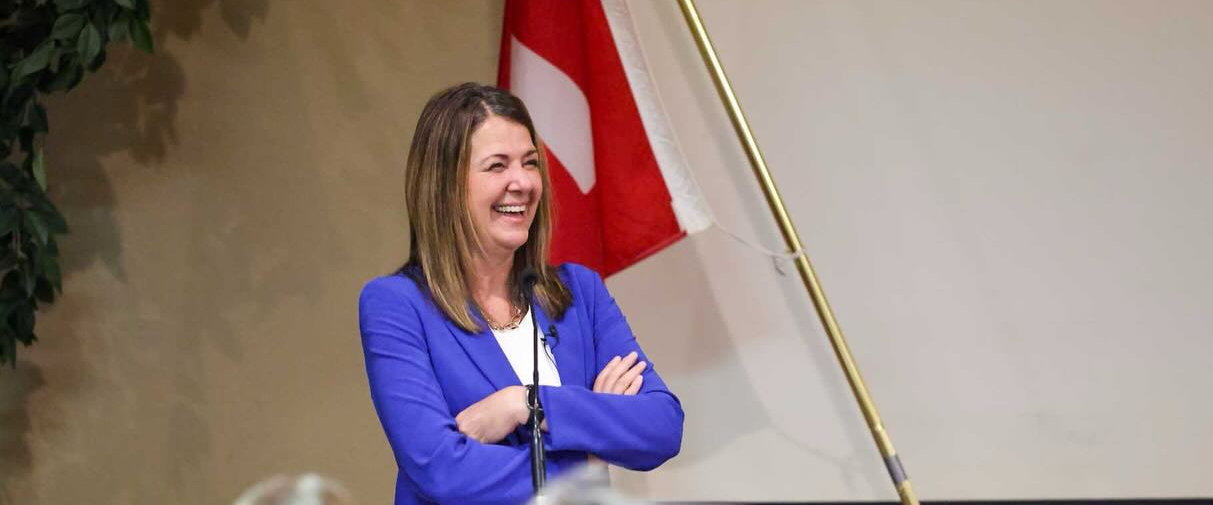
Alberta Premier Danielle Smith says growing discussion around Alberta independence reflects long-standing frustration with Ottawa, not a desire to become part of the United States.
Smith made the comments on Jan. 24 during her weekend radio program Your Province. Your Premier., responding to remarks by U.S. Treasury Secretary Scott Bessent, who suggested Alberta could be a “natural partner” for the United States and referenced the possibility of a future referendum on whether the province should remain in Canada.
“When I speak with Albertans who feel frustrated by the federal government over the last decade, they are not saying they want to become an American state,” Smith said. “What they are asking for is a better deal within Canada.”
Bessent, speaking during a Jan. 23 interview on the U.S. network Real America’s Voice, criticized Canada’s failure to approve a west-coast oil pipeline for Alberta crude and suggested the province could instead deepen energy ties with the United States. He added that some Albertans were talking about “sovereignty” and wanting the freedoms enjoyed by Americans.
Smith pushed back on that framing, saying the message she hears consistently is about reforming federal-provincial relations, not abandoning Canada. “Albertans want a new relationship with Canada, and that’s what I’m working toward,” she told host Wayne Nelson.
Recent polling suggests that while dissatisfaction with Ottawa is widespread, outright separation remains a minority position. A May 2025 survey by Leger found that 29 percent of Albertans support independence, while two-thirds oppose it. A more recent Pollara poll released Jan. 9 showed support at 19 percent, with 75 percent saying they would vote to stay in Canada.
Earlier this month, Elections Alberta approved a citizen-initiated petition question on Alberta independence. Organizers now have until May 2 to gather 177,732 signatures for the question to qualify for a referendum.
The proposed question, submitted by the Alberta Prosperity Project, asks whether Alberta should leave Canada to become an independent country.
APP CEO Mitch Sylvestre said his movement is not advocating for Alberta to join the United States. “People admire American sovereignty, but what we want is sovereignty of our own independent from both Ottawa and Washington,” he said.
Smith has repeatedly said she does not personally support separation, but maintains that if citizens meet the legal threshold for a referendum, her government will respect the democratic process.
That stance has drawn criticism from Alberta NDP Leader Naheed Nenshi, who accused the premier of legitimizing separatist sentiment. In a Jan. 24 video posted online following an interview on Power & Politics, Nenshi said Smith should clearly denounce separatism and affirm national unity.
The independence push has also triggered legal action from a northern Alberta First Nation, which argues that a separation referendum could infringe on treaty rights. Addressing that issue on her radio show, Smith described the petition process as a way for public frustration to be expressed peacefully. “Democracy needs pressure-release valves,” she said. “This is clearly an issue a motivated group of people care deeply about.”
Despite the separatism debate, Smith emphasized that Alberta and Canada remain closely tied to the United States through trade. She said Canada has been “a great partner” to the U.S. and argued that upcoming renegotiations of the Canada-United States-Mexico Agreement should focus on resolving specific disputes rather than reopening the entire deal.
“About 97 percent of Alberta’s goods cross the border tariff-free,” Smith said, pointing to ongoing disagreements over steel, aluminum, autos, softwood lumber, pharmaceuticals, and digital trade as areas needing targeted negotiation.
Smith also expressed optimism about Alberta’s relationship with Ottawa following the signing of a memorandum of understanding with Prime Minister Mark Carney on Nov. 27, 2025. The agreement outlines a framework to build one or more pipelines to the B.C. coast, contingent on private investment, while adjusting several federal energy regulations.
In exchange, Alberta committed to higher industrial carbon pricing, reduced methane emissions, and pairing any new pipeline with large-scale carbon capture projects.
Federal Finance Minister François-Philippe Champagne also weighed in on Bessent’s comments, saying Canada would continue developing its resources “with Albertans and with Canadians,” and made clear that such decisions remain a domestic matter.
For Smith, the focus remains on economic growth and national cooperation. “We’ve got a new prime minister, a new agreement, and common ground on opening new markets,” she said. “That’s where my attention is and that’s what Albertans expect.”

