
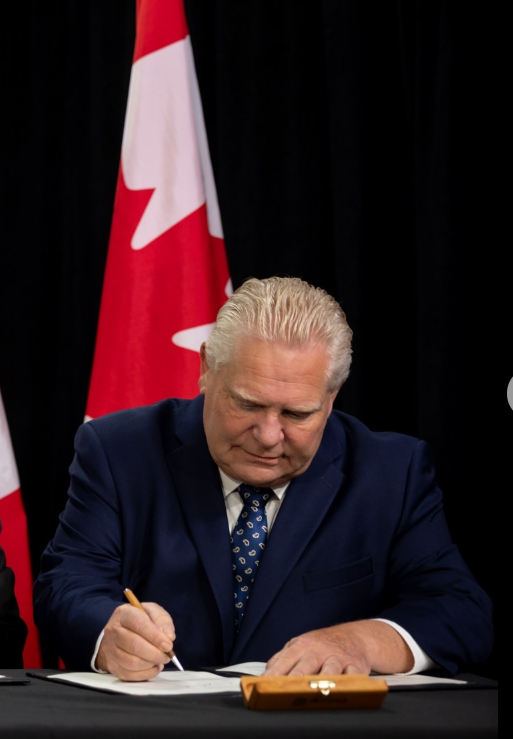
By all appearances, Ontario’s Progressive Conservative government wants to “return to tradition.” At least, that’s how Attorney General Doug Downey framed the Ford government’s proposal to eliminate fixed election dates, boost political donation limits, and cement public subsidies for political parties. But peel back the nostalgia, and this plan looks far less like a return to roots and far more like a strategic power play.
Let’s start with the big one: doing away with fixed election dates. Introduced two decades ago by the McGuinty Liberals, the rule requiring elections every four years brought predictability and fairness to Ontario’s democratic process. Voters, political parties, and watchdog groups could plan around a clear timeline, making elections less about political gamesmanship and more about accountability.
Now, Ford’s government says fixed dates are “American style,” and that scrapping them will “return Ontario to an electoral process that served us well for nearly a century and a half.” But that’s a selective version of history. Before fixed dates, premiers could call elections whenever it suited them often when polling numbers were high, or opposition parties were weak. That system gave an enormous advantage to the governing party. And Ford’s government, which already used that flexibility earlier this year to call a snap election ahead of schedule, seems eager to keep that advantage.
Under the proposed changes, the government’s mandate would stretch from four years to five. That means Ford’s next election wouldn’t happen until 2030 instead of 2029 unless, of course, he decides to call one earlier. The justification? The government claims it needs flexibility to respond to “changing circumstances” and “external threats.” In reality, it sounds like a license to hit the reset button whenever it’s politically convenient.
Then there’s the increase in political donation limits from $3,400 to $5,000 a year. Downey insists this is in line with other provinces, but let’s be honest: it also gives wealthy donors more influence. The Ford government’s critics, including NDP Leader Marit Stiles, are right to raise red flags. Ontario’s political history is littered with stories of “cash-for-access” events and well-connected insiders writing big cheques. Raising donation caps only tilts the playing field further toward those with deep pockets.
Yes, the government plans to make the per-vote public subsidy permanent a move that supports smaller parties and maintains balance. But this appears to be the lone nod toward fairness in an otherwise lopsided proposal.
Even more concerning is the push to remove pre-election spending limits for third parties and political groups. These limits were originally designed to curb the influence of powerful organizations in shaping public opinion before an election campaign officially begins. Removing them risks turning Ontario’s elections into an unregulated ad war where money talks louder than policy.
It’s no surprise that opposition parties see these moves as self-serving. NDP Leader Marit Stiles called it out plainly: “The Ford government has a track record of favouring big donors and insiders over the people of Ontario.” Liberal parliamentary leader John Fraser went further, noting that amid job losses, struggling schools, and overwhelmed hospitals, these political reforms are an odd and telling priority.
In a time when trust in institutions is fragile, Ontarians deserve reforms that strengthen democracy, not weaken it. Returning to the days of surprise election calls, bigger donor influence, and looser spending rules doesn’t sound like progress it sounds like a calculated regression.
If Premier Ford truly wants to serve the people of Ontario, he should focus on restoring public confidence, not rewriting the rules of the game to his advantage. Because in democracy, timing and money shouldn’t be the tools of those already in power they should be equal rights for everyone.

