
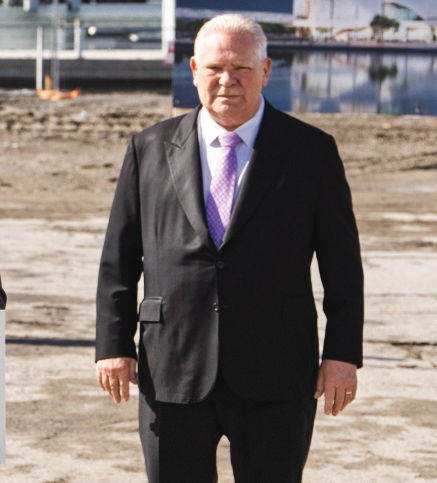
Ontario Premier Doug Ford did not mince words when a reporter brought up a recent court ruling blocking Waterloo Region from evicting a homeless encampment from a key transit construction site. Standing at an unrelated press conference in Sault Ste. Marie, Ford called it the most absurd judicial decision he had ever encountered and suggested the judge who made it should have the campers on his own front lawn.
“It’s the most ridiculous ruling I’ve ever seen,” Ford told reporters Thursday. “For what, 30 people, they’re going to hold up millions and millions of riders, communities and everything.”
The decision in question was handed down May 21 by Justice Michael R. Gibson of Ontario’s Superior Court of Justice. In an 88-page ruling, Gibson found that a site-specific bylaw passed by Waterloo Region to remove roughly two dozen homeless individuals from a gravel parking lot at 100 Victoria Street North in downtown Kitchener violates their rights under the Canadian Charter of Rights and Freedoms.
The lot sits at the heart of a major infrastructure project the Kitchener Central Transit Hub (KCTH), a joint undertaking between Waterloo Region and provincial transportation agency Metrolinx. When complete, the hub is expected to consolidate GO Transit, VIA Rail, and intercity bus service into one central terminal. Construction is slated to begin later this year, with a projected completion date of 2030. The Victoria Street lot is earmarked to store construction equipment and materials during that process.
Gibson was unsparing in his description of the encampment itself: “No one should romanticize or be starry-eyed about the Encampment,” he wrote. “It is a miserable and desperate place.” Even so, he concluded that it “represents the only remaining safety valve for the Region’s homeless as a refuge of last resort” noting it is currently the sole location in the entire region where unhoused people can legally pitch a tent.
Under his ruling, the region cannot clear the site unless it first provides “an alternative lawful encampment site of last resort, or a tenting protocol that facilitates access to essential services and healthcare on par with the current encampment.” Gibson pointed to London and Thunder Bay as examples of Ontario municipalities that have already created designated legal encampment zones, and indicated the region could return to court for further direction if it moved in that direction.
The encampment at 100 Victoria Street is not a new flashpoint. Homeless individuals began settling there in December 2021, and the region has been locked in a legal battle to remove them ever since without success.
An Ontario Superior Court justice ruled in January 2023 that the region’s earlier attempts to clear the site violated residents’ rights to life, liberty, and security, partly because shelter beds in the area were outnumbered by the homeless population.
Since then, Waterloo Region has significantly ramped up its spending on homelessness programs, more than doubling its annual operating budget in the space of two years from $30.9 million in 2022 to $65.5 million. Yet Gibson noted in his ruling that the crisis has continued to deepen despite those investments. The count of homeless individuals in the region climbed from 1,085 in September 2021 to 2,371 as of October 2024.
Regional councillors passed the site-specific bylaw targeting the Victoria Street encampment in April 2025, followed by an amendment in January of this year, with an April 1 deadline to clear the site. That timeline has now been thrown into legal uncertainty.
Ford, who said he has spoken with Waterloo Region Chair Karen Redman, local mayors, and Attorney General Doug Downey in the wake of the ruling, made clear he disagrees with Gibson’s decision though he added, somewhat pointedly, that he holds the judiciary in high regard.
“I have a great deal of respect for judges,” the premier said. “But [Gibson] comes out with this cockamamie idea that they’re going to hold up transit.”
He went further, suggesting the encampment residents be relocated to the judge’s personal residence.
“I wish I could get that guy’s address and send 50 encampments in his backyard and see how he likes it,” Ford said.
This is not Ford’s first collision with the courts over encampment policy. In 2024, he floated the idea of invoking the notwithstanding clause to shield municipal eviction efforts from Charter challenges, following a request from 12 Ontario cities for provincial intervention on encampments and drug use in public spaces. In June 2025, his government passed the Safer Municipalities Act, aimed at clearing public spaces of illegal drug activity, and in January of that year announced a $75.5-million package that included housing and service supports for encampment residents.
Not everyone shares Ford’s frustration. Waterloo Region Community Legal Services, which represents the encampment residents, welcomed Gibson’s ruling warmly.
“We remain hopeful that the Region and all levels of government will move forward with thoughtful, lasting solutions to address homelessness,” the organization said in a statement posted to its website on May 22.
Gibson himself acknowledged in his decision that the transit hub is “a genuine public interest” but maintained that the project can still be completed “while respecting the rights” of those living at the site.
Whether Waterloo Region will appeal, seek a designated encampment location, or pursue another path forward remains to be seen. In the meantime, the tents at 100 Victoria Street North stay put and a multimillion-dollar transit project waits.

