
I have been involved in journalism and writing for more than forty years. Yet, I still do not have a home or flat anywhere in the world. Whenever I come to Dhaka, I stay at someone else’s house, and when I visit Bagerhat, I stay at a guest house in the Bagerhat Club. But I don’t feel any regret or desire for something more because of this. I remembered these words after reading a news article in the newspaper about 830 people being awarded plots for their “extraordinary contributions.”
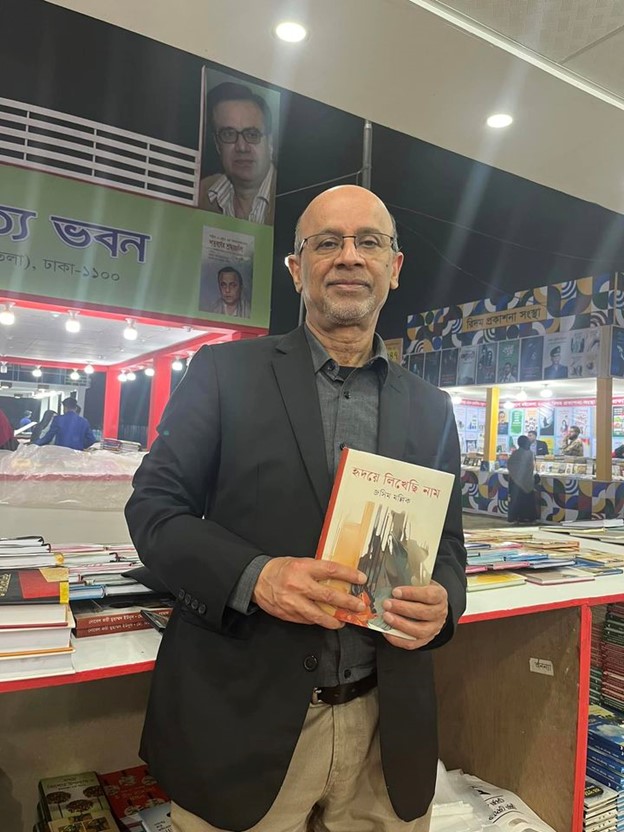
My romantic thriller novel Tomar Swapner Hate (In the Hands of Your Dreams) has been published. The novel addresses the contemporary life, society, the country, state corruption, terrorism, and more. Despite the decay and breakdowns, the dream of doing something good for society and humanity survives. The novel focuses on the spirit of the Liberation War and the desire to build the country, human relationships, love, and responsibility. It depicts the rural setting, the city, the country, rivers, mother, siblings, friendship, and the yearning in people’s hearts. It discusses relationships between people, the bond between parents and children, the desire to live, the struggle with illness, and mutual trust and dependence. I have always loved writing about the human mind. The love in the novel appears in a different form and unspoken language. This novel is published by Rhythm Publications, with an aesthetic cover designed by Masuk Helal. The Rhythm stall number is 47 and 48.
At one time, I disliked the kitchen. Many people, including writers and journalists, enjoy being in the kitchen. They love cooking and can do many things. I was working at Bichitra at the time, in 1984/85. One day I visited a writer’s house, and he cooked a wonderful potato dish for us. I was amazed that such a well-known writer could cook! That’s when I decided I would learn to cook, but I never did. After coming to Canada, I understood the importance of the kitchen. Even though I couldn’t master much else, I quickly learned how to make tea, cook rice, fry eggs, and cook lentils, just to survive. My friend Alam in Toronto is an excellent cook and has taken cooking to an art form. I have been greatly inspired by him. He often tells me to learn it, as it’s important for independence.
However, I never quite got around to it. Nowadays, I sometimes hover around the kitchen near Jasmine. She, too, took cooking training after coming to this country. My daughter, Oritra, can cook now. Most expatriate women can do so. Daughters now handle everything with both hands. When Jasmine would leave me alone and go back to Bangladesh, my relatives or friends would supply me with food, and I would enjoy it. But now, I try to make some things myself. Jasmine seems pleased with my efforts. She never used to let me into the kitchen before, but maybe she’s tired now. After a while, all tasks become monotonous. Women work outside, raise children, do the groceries, and then take on the cooking responsibilities. How is that fair? This should not be allowed. Work should be divided equally. After all, men cannot bear children! If they could, they would understand the pain of childbirth.
Toronto, Canada

