

Charles Pachter emerged as one of Canada’s great artistic icons during the 1960s and 1970s. His enduring passion and unique perspective on Canadian symbols and institutions have often been expressed through his work. Reflecting on what he once described as “the ultimate colonial symbol,” the Queen, Pachter has played the roles of observer, documentarian, and artistic commentator, delving into the intersection of nostalgia, irony, and philosophical exploration. He captures the pivotal moments of a nation’s memory, offering profound insights through his artistic interpretations.
In one of Pachter’s notable paintings, the Queen is depicted riding on the back of a moose, a large deer-like creature native to North America, while waving her gloved hand as though acknowledging the rural landscape from her limousine. This striking imagery serves as both a poignant memory of colonial history and a satirical jab at its fragility. When Pachter learned of Queen Elizabeth’s upcoming visit to Niagara in June 1973 to inaugurate the Shaw Festival Theatre, he was inspired to create this artwork. It became the beginning of a series that established his name in Canadian households and elevated his paintings to iconic status in contemporary Canadian art.

Early Life and Education
Born in Toronto, Canada, in 1942, Charles Pachter is a multifaceted talent—a painter, printmaker, sculptor, designer, historian, and lecturer. He earned his undergraduate degree in Art History from the University of Toronto and studied French Literature at the Sorbonne in Paris. He completed his Master’s in Fine Arts, focusing on Painting and Graphics, at the Cranbrook Academy of Art in Michigan, USA.
It is worth noting that his Master’s project itself was a monumental contribution to North American art. During his time at the University of Toronto, Pachter developed a close friendship with celebrated Canadian author Margaret Atwood. Atwood began sending him poems about Susanna Moodie, a distinguished 19th-century poet and writer (1803–1885). She suggested that illustrating these poems could be an excellent project for his Master’s. Pachter enthusiastically embraced the idea, and the collaboration culminated in the 1970 publication of The Illustrated Journal of Susanna Moodie, an iconic blend of poetry and visual art. This groundbreaking work became a sensation in the Western art and literary world, discussed widely in households and cafes. Original copies, printed on handmade paper crafted by Pachter himself in the university lab, sold for thousands of dollars.
Accomplishments and Recognition
Pachter’s works are displayed at the Art Gallery of Ontario and the Royal Ontario Museum and are part of both public and private collections across Canada and internationally. He has held solo exhibitions in countries such as France, Germany, Japan, the UK, India, and Bangladesh.
He is an Officer of the Order of Canada and a Chevalier of France’s Order of Arts and Letters. He has received honorary doctorates from Brock University, the Ontario College of Art and Design University, and the University of Toronto.
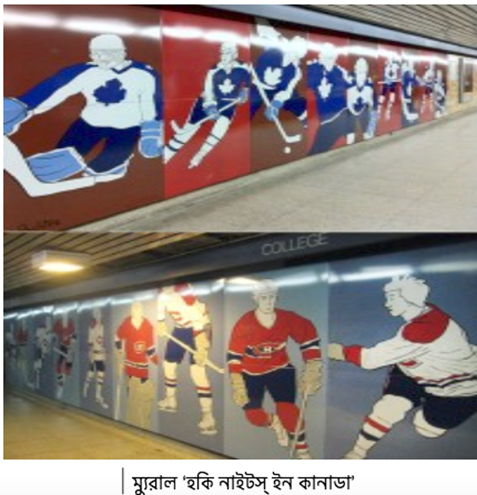
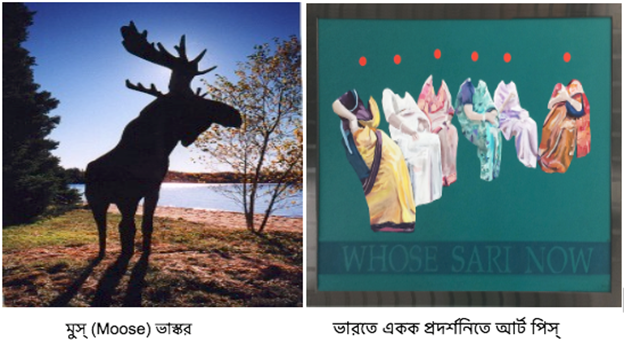
Pachter resides in downtown Toronto, where his award-winning art studio is located. His iconic mural Hockey Nights in Canada adorns the walls of the popular College subway station in Toronto, open to the public. His paintings are also exhibited in prestigious venues such as the Canadian Portrait Gallery, the Canadian Embassy in Washington, the Canada House in London, Parliament buildings, the Prime Minister’s residence, and the French Embassy in Ottawa. His sculptures of moose, crafted in steel and granite, are installed at various locations across Canada.
Books and Legacy
Pachter’s best-selling children’s books include M is for Moose and Canada Counts, alongside The Illustrated Journals of Susanna Moodie, published by Cormorant Books in Toronto.
Connection to Bangladesh
In February 2018, Charles Pachter attended a solo exhibition of his works at the Nalini Kanta Bhattasali Gallery in Bangladesh’s National Museum. The display left art lovers and visitors in awe as they explored Canada’s contemporary artistic heritage through Pachter’s representations of symbols like the moose, the maple leaf, and his timeless reflections. The exhibition inspired Bangladeshi artists with its depth and symbolic resonance.
This vibrant cultural event opened a new chapter of collaboration between Canada and Bangladesh. It showcased how Canada, built by the roots of people from all corners of the world, shares a connection with Bangladesh. For Bangladeshi artists, the exhibition was a window to expand their horizons and engage with global artistic dialogues.

