
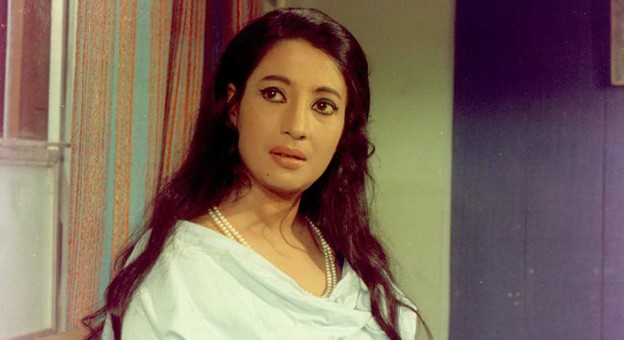
January 17, 2014, was a Friday. The sad news, which was colder than the coldest of winter winds, suddenly came out of the ether. The great heroine of Bengali cinema and Indian cinema, Suchitra Sen, left this world at 8:25 am today, leaving her fans and admirers in a sea of sorrow and passed away forever. With the broadcast of this condolence news, her films, songs and various programs about her started to be broadcasted on channel by channel. Within a moment, the day became Suchitra Suchitra.
If you are born in this world, death is inevitable. There was no deviation from this rule in the case of the great heroine. Although she left this world very naturally, it was a matter of great difficulty for her fans to accept her departure. After being a silent actress for almost 35 years, this last journey of hers was a dream death for her fans. Because Suchitra Sen, who went from heroine to great heroine, was a princess in the eternal dreams of her millions of fans. Through her eternal journey, a beloved name, an institution, and a legend cherished for thousands of years in Bengali cinema, has passed away.
Then, gradually, in the spinning world, the seconds, minutes, hours, weeks, days, and months have passed and three years have passed since the great heroine’s great departure, but her appeal remains exactly the same as before. It has not faded at all. Even though she chose a life of seclusion for a long time, she was never hidden from the hearts of her fans. Until her death, she was an embodied image painted on the canvas of countless fans’ hearts.
Suchitra Sen – a name, a history, a wonder. For ages, she has not had to be introduced to anyone anew. What qualities did she have that made her a strong presence in the hearts of her fans? In response to this question, the question arises as to what tricks did she have to attract them. Skillful acting, heart-pounding eyes, speaking style, world-class smile, peacock-like chin and neck-curling gaze, extraordinary personality, only then did she become an incomparable Suchitra Sen, who has no comparison.
Suchitra Sen was born on April 6, 1931, in Pabna city, Bangladesh. Rama Dasgupta was the third of seven children of Karunamoy Dasgupta, Sanitary Inspector of Pabna Municipality, and mother Indira Dasgupta. Rama, who was endowed with an incomparable beauty and fair complexion, was called Krishna by her father. In 1947, she married Dibanath Sen, a businessman and a third-generation member of the traditional Dinanath Sen family. After marriage, she took her husband’s surname and became Rama Sen. Later, she appeared in films under the name Suchitra Sen. On 7 February 1953, she made her debut as Suchitra Sen in the Bengali film ‘Saat No. 1 Kaiyedi’ directed by Sukumar Dasgupta. Director’s assistant Nitish Roy gave Rama a new name, Suchitra Sen.
Although her acting career began with ‘Shesh Kothay’, the film never saw the light of day due to the fact that it was stopped midway. The first Bengali film she acted in was ‘Saat No. 1 Kaiyedi’. And the last film was ‘Pranoy Pasha’ directed by Mangal Chakraborty in 1978. In her 25-year (1953 to 1978) acting career, she acted in about 60 Bengali and Hindi films. Of these, 7 were Hindi films. The films are ‘Devdas’, ‘Dekhneh Mein Bhola Hai’, ‘Bombay Ka Babu’, ‘Musafir’, ‘Champakli’, ‘Aandhi’ and ‘Mamta’.
Although the first full-length Bengali film was launched in 1931 with ‘Jamai Shashti’ directed by Amarendranath Chowdhury, the 1950s were essentially a time of preparation for independence in the northern subcontinent, namely India, Pakistan and East Bengal. The highest expression of Bengali creativity occurred in the 1960s. The 1960s were very important in other areas of life, including literature and art, music, cinema. In other words, the 1950s and 1960s were the years of Bengali creativity. And Suchitra Sen became the queen of screen dreams in these two decades. The life of the depressed Bengalis, who were plagued by the post-partition refugee period, found a place to breathe a little relief in the celluloid tape. In the films of the Uttam-Suchitra duo, Bengalis found a taste of their familiar life. In 1953, Suchitra Sen firmly established herself in the hearts of Bengalis through Nirmal Das’s film ‘Sade Chuattoor’. Uttam-Suchitra were paired together for the first time in this film. The rest is history. What is written in golden letters in the jewelery of the Bengali mind. This romantic pair emerged as a piece of life in the declining life of Bengalis. No other pair has created such a stir in films like this eternally romantic pair. Starting with the first hit film ‘Sade Chuattar’, then one by one ‘Agni Pariksha’ (1954), ‘Shapamochan’ (1955), ‘Sabar Upadha’ (1955), ‘Sagarika’ (1956), ‘Harano Sur’ (1957), ‘Pathe Holo Deri’ (1957), ‘Rajalakshmi O Srikanth’ (1958), ‘Suryatoran’ (1958), ‘Indrani’ (1958), ‘Bipasha’ (1962), ‘Saptapadi’ (1961) and many more films were presented by this greatest romantic duo of all time. Suchitra Sen’s enchanting look, sweet smile, emotional tears, gomra-mukhi pride, immense beauty and acting talent captivated young and old Banita, an obsession that remains unbroken in the hearts of her devotees till today. However, apart from the pairing tradition, the fact that he was equally popular with the audience is evidenced by the other films he acted with other heroes. His acting skills in Bengali and Hindi films like ‘Hospital’ (1965), ‘Devdas’ (1954), ‘Musafir’ (1957), ‘Aandhi’ (1975), ‘Bombay Ka Babu’, ‘Saat Pake Bandha’, ‘Uttar Falguni’ (1963), ‘Mamta’ etc., paired with Ashok Kumar, Dilip Kumar, Sanjeev Kumar, Dev Anand, Soumitra Chatterjee, etc. prove once again that he was never indifferent to any film apart from Uttam Kumar.
Just as the mid-fifties to mid-seventies are considered the golden age of Bengali cinema, that period is also considered the golden age of Bengali music. Because the timeless songs of Bengali music were created in that golden age. Lyricists like Gouri Prasanna Majumdar, Bimal Ghosh, vocalists like Sandhya Mukhopadhyay, Geeta Dutt, Aarti Mukhopadhyay, Lata Mangeshkar, Hemanta Mukhopadhyay, Manna De, Shyamal Mitra and actors and actresses like Suchitra Sen and Uttam Kumar are just a few names who were woven together like a pearl necklace and were brilliant in their own fields. In the film ‘Saptapadi’, Suchitra is riding on the back of Uttam’s motorcycle on her way to the village. Birds are flying in the sky. Suchitra’s smiling face is near Uttam’s neck on the winding road of the village. What was a rare romantic scene in those days. Uttam sings in Hemant’s voice, “If this path is not finished, then what would it be like, you tell me.” “You tell me,” “No-no you tell me,” and no one has said anything more. This is like a truly endless journey on the path of love that will never end. There are many more songs with romantic scenes like this that make the heart flutter. “You are mine” in the film “Lost Sur,” “Ai Sundar Swarnali Shuddha” in the film “Hospital” with Ashok Kumar on a boat, “Ei Sundar Swarnali Shuddha” in the film Indrani, “Neer Chota Khatta Nei” and so on. There are countless other songs that create appeal as before, resonate in the hearts of the audience.
Glamour, romantic image, hairstyle, clothing, eternal Bengaliana, simple lifestyle, above all, Suchitra Sen, who has become a fashion icon for Bengali women with her silvery softness, has won numerous awards in her acting career, including international awards, and received the Padma Shri Award in 1972. She refused the Dadasaheb Phalke Award in 2005, not wanting to come in public. She received the highest honor of the West Bengal government, ‘Bangabibhushan’, in 2012. She was the first Indian actress to win the Best Actress Award at the Moscow International Film Festival in 1963 for the film ‘Saatpak Bandha’. She won the Best Actress Award in 1955 for the first Hindi film ‘Devdas’. She was nominated for the Filmfare Award as the Best Actress for her performance in the film ‘Aandhi’, which was filmed in the style of Mrs. Indira Gandhi. Moreover, this popular actress has won numerous awards in West Bengal.
When it was almost impossible for women to escape from the life confined by the four walls, Suchitra Sen made the path of the entire female race easier by entering the film industry and boldly declaring her existence. What is meant by women’s empowerment, that is, the ability of women to make independent and sovereign decisions by preserving individual rights and social universality in personal, family, social, etc. fields, by becoming strong in self-power, was perfected through Suchitra Sen. Her decision-making power was extraordinary from the beginning to the end. In her case, beauty and intelligence seemed to complement each other. While being in the midst of fame and popularity like Hollywood’s proverbial actress Greta Garbo, Suchitra Sen, after acting in the film ‘Pranoy Pasha’ in 1978, withdrew from the acting world and public life and chose her own life of voluntary exile in the shadows.
Although many people have made many negative comments about this voluntary exile of almost 35 years, she remained steadfast in her decision. Although various issues such as unhappy married life, separation from her husband and her untimely death in 1969, inclination towards spirituality, death of Uttam Kumar etc. have been attributed as the focal points of her voluntary exile, the real reason has always remained a mystery. The Suchitra Sen that the audience is familiar with was 45 to 46 years old. The image that emerges in the minds of Suchitra fans is the portrait of the eternal youth Suchitra Sen roaming the silver screen. And as this eternal youth, she will live in the hearts of the audience for the rest of her life. No one knows Suchitra Sen, who has reached old age in exile, except her close relatives. This is the greatest satisfaction of her life. By adopting this unique technique of remaining in the memory along with acting, the one who was able to establish a permanent and firm seat in the hearts of the audience is none other than Suchitra Sen. Even though many things in this mortal world are lost in the abyss of oblivion, Suchitra Sen will remain immortal forever. As long as Bengali, Bengalis and the Bengali language live, this uncrowned empress of Bengali cinema, the legendary heroine, beloved by all, will remain immortal in the hearts of Bengalis.

