

The book The Swastika, by seventy-seven scholars, is the most comprehensive study of the history and use of the symbol in the world. The author, Thomas Wilson, was involved in the excavation of an Indian tomb in Ohio, where he discovered several large copper swastikas. This unusual find piqued Wilson’s curiosity and led to research that eventually resulted in the book The Swastika.

{Originally published under the auspices of the United States National Museum (now the Smithsonian).}
The swastika symbol was found in Mesopotamia and India 8,000 years ago and is abundant in artifacts discovered at various sites in ancient Troy. It also appears on hundreds of Greek ceramic objects from the Geometric period. Between the 10th and 7th centuries BC. Its use by indigenous peoples along the Mississippi and Amazon rivers before 300 AD raises important and serious questions about its possible spread from Eurasia! How or when did this happen? However, no one has ever established its meaning, or if it did, it was unknown to many. That is, whether the swastika’s underlying meaning was ever fully understood by Europeans seems to be unknown to many. Or more extensive research is needed.

The cover image above is taken from Gregory Haynes’s book Tree of Life, Mythical Archetypes, also published by Symbolon Press. Haynes was the first to see that the four largest rivers of the four continents bordering the Atlantic Ocean (Nile, Amazon, Mississippi, and Baltic) are related to each other like the outer arms of a giant swastika, centered on the blue waters of the Atlantic Ocean. In Tree of Life, Mythical Archetypes, he argues persuasively that ancient navigators mapped these four rivers and derived from them the image of the swastika.
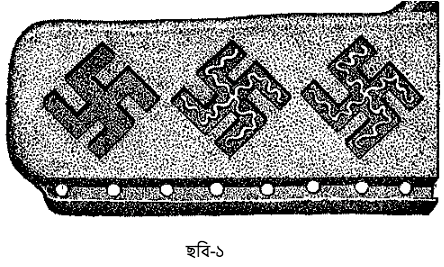
This illustration from Thomas Wilson’s The Swastika (Fig. 1) shows a series of swastikas carved on a bronze cincture (in the form of a belt) from the Caucasus. The swastikas bear a vague image of four of the rivers flowing through each arm and intersecting at the center, in two images. This is consistent with other archaeological evidence indicating that the swastika bears a strong association with rivers.
Another illustration of Thomas Wilson’s ‘The Swastika’ (Image 2) shows a bronze pin from Bavaria. The four swirling river-symbols parallel the arms of the swastika.
He found over 450 such depictions of the swastika.

