
From the earliest times of creation, the public has felt the need for engineering or technical knowledge. But as a necessary catalyst for the discovery of what its nature would be, there was still no way to create an idea that could be understood within the scope of human limited knowledge. But over time the natural needs of man have long been felt and though initially on a small scale man has continued to strive to realize them in his thought, thought and technical thought.
Humans have gradually been able to identify their basic and essential needs over thousands of years using the same formula. In that view and overall necessity people have continued to involve engineering and technology in social and economic activities with a view to improving their lives and have devoted themselves to its development. In these activities that started from very ancient times, the various civilizations of the world have continued the process of engineering development at a greater level in their respective times and this is our current world today with the extreme excellence of technology. The discovery, development and use of all classes of engineering and technical education that has been ongoing for ages, the technology process in this phase of the 21st century has been regarded as the bearer of a global industrial revolution.
The early history of technology and its development dates back centuries or may be called millennia to a practical culture. People are increasingly realizing the need for practical education to meet the needs of daily life. Canadian engineering can be broadly divided into two majors on the basis of its excellence. The first is the situation before and after European settlement in Canada. As we review the history of technology and Canadian industrial development, we find that the continuous development of engineering and technology has revolved around communications, information technology, heat and power, public works and public services, food and its production systems. Over time, all the technologies that have spread in Canada are mainly sourced from different countries of the world, and especially from Europe, and only a small number of technologies are sourced from Canada. Among the technologies used today, they are breakthrough inventions called ‘The Canada Arm’, ‘Cardiac Pacemaker’, ‘IMAX’, ‘Walkie-Talkies’, ‘Alkaline Batteries’, ‘Insulin’, ‘Global Time Zones’. In addition, in 1874, the world’s two notable practical milestones, the telephone and the light bulb, were discovered in Canada.
The layers of time are referred to by scientists as different eras, partly literally and partly metaphorically, in terms of the age and development of the Earth. All those era names are supposed to try to keep up with the chronological invention. It can be said that a particular period is named in connection with a discovery, but the name of the previous period is adopted without including the period of any new revolutionary discovery. The periods or eras that have been identified as preceding the arrival of Europeans in the Americas or Canada include the Stone Age: Fire – 14000 BC to 1600 AD; Age of Soil: 1600 – 1830 AD; Steam Age: 1630 – 1880 AD; Early Electric Age: 1800 – 1900 AD; 20th century: 1900 – 1999 AD and 21st century till present time: 2000 – 2024 AD. The technologies invented over the ages have been determined as determinants and regulators of major improvements in the history of human civilization, which are established as indicators of human development throughout the world.
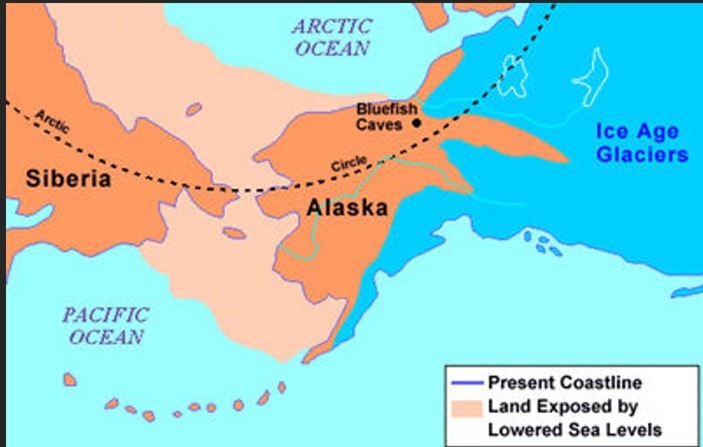
According to various sources, people arrived in this marginal area of the Northern Hemisphere approximately 12,000 years ago. People arrived in Alaska through an ancient land bridge from present-day Siberia, which is now called the Bering Sea, and they gradually spread to different areas of North America and gradually started settling there ( Note: Image below). The Metis and Inuit peoples, including what we call First Nations or Indians in this area, began to realize the need to protect themselves, gather food, travel and survive in these harsh winters, and tried to invent different strategies.
As a result, they gradually developed kayaks and canoes, igloos, teepees or conical tents, snowshoes, moccasins or leather slippers, longhouses, palisades, dogsleds, toboggans, red river carts, various tools and hunting equipment made of animal bone or metal. It greatly helps the inhabitants in fishing and hunting.
On the other hand, the explorers and immigrants who came to Eastern Canada, initially from France and later from Britain, gradually got a proper idea from the natives of this area about the tools, machinery, native boats and land vehicles suitable for ice, and the techniques of building special types of houses suitable for winter. On the contrary, the indigenous communities of Canada also began to acquire knowledge about the technology and technical aspects of the European ideas and tried to use those technologies in the Canadian reality. It is considered a very fruitful step considering Canada’s perspective and needs by combining indigenous technology with more advanced European technology. As all these steps are timely, new projects are undertaken which gradually make the life of the tribals and migrants more easy.
As a result of the improvement and use of all these types of technology, great progress was made in the construction of stone forts, sea or river ports, discovery and development of deep waterways, etc. Adoption of these technologies, innovations and inventions in the field of maritime transport create huge advantages in the movement of large ships or other vessels and the transportation of goods. In addition, the use of technology in the removal or drainage of wetlands has played a significant role in the success of shipping. As the main mode of transport, waterways created great enthusiasm and a large locally built steamboat, the Prince William, had already crossed the Atlantic.
In the early 19th century, Canada embarked on a major European-style industrialization program, and as part of this, paper mills were established to produce paper from wood pulp. At that time, factories for the construction of sailboats were established in various places on the Atlantic coast to speed up transportation. The construction of steamboats greatly improved transportation and freight on the major rivers and lakes of the area. Apart from this, various canals were excavated there for the convenience of transport and travel and the tools and machinery required for the excavation work started to be produced locally. Some engines for steamboats are also manufactured locally. Railway lines and telegraph lines were also built there, which generally made the conditions favorable for settlement in those areas. In the mid-19th century, a submarine telegraph cable connected Newfoundland and the British Isles.
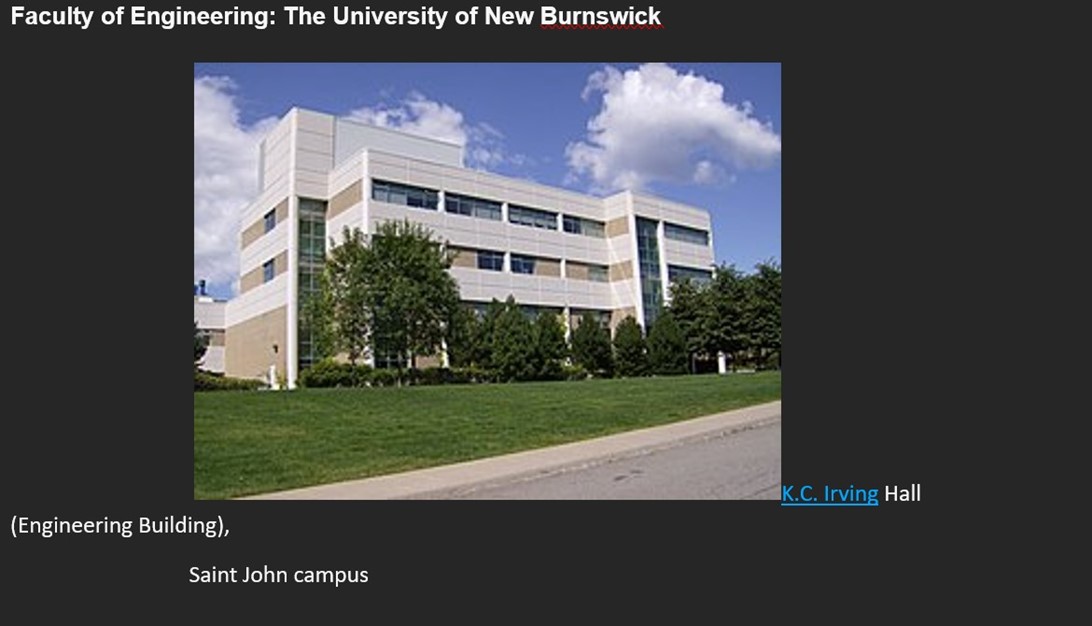
In the changing situation, successive successes and developments in the field of engineering have led to massive growth in the country and strong enthusiasm has been observed in the industrial sector, which has given a profound direction to the need for technical education and the acquisition of skills for its practical application. With that vision, Canada’s first engineering faculty was opened in 1854 at the University of New Brunswick.
Along with basic branches of engineering i.e. civil, mechanical, electrical, chemical engineering, geological engineering department was opened jointly with science faculty. The field of knowledge and research about land, infrastructure and other resources is greatly expanded due to the integration of this department into engineering education. Canada’s geographic location, climate, water and mineral resources related to knowledge and its application plays a major role in the socio-economic development of the country. At the same time government regulatory bodies and commissions were formed to manage and control various development activities. From the opening of the Faculty of Engineering at the University of New Brunswick to the outbreak of the First World War, the field of technological development and the institutional framework of Canada expanded rapidly, some chronological examples of which are given below:
AD – 1879 : Standard Time
AD – 1880: Bell Telephone Company founded
AD – 1880: Electric Power
AD – 1880: Coal Company
AD – 1901-02: Nickel and Aluminum Company
AD – 1903: Mining Industry
AD – 1904: Establishment of The Regiment of Royal Honourers
AD – 1906: Formation of Hydroelectric Power Commission
AD – 1909: Boundary Water Treaty signed between Canada and the United States
AD – 1910: Establishment of The Steel Company of Canada
AD – 1911: Establishment of The Royal Canadian Navy
AD – 1914: Establishment of The Dominion Coal Company
AD – 1914: Establishment of Department of Highways
From the beginning of the 20th century, or it can be said between the First World War and the Second World War, all the engineering and technological improvements that have occurred were mainly confined to the development of tanks, airplanes and warships, and the development and use of new technologies. But at the end of the World War, the United States, one of the two superpowers, engaged in a lot of research in other engineering fields besides weapons and became the father of many breakthrough discoveries. Although Canada is bigger in size as a neighboring country, it lags behind due to its relatively small population and small economy, but several important inventions have been invented by Canadian scientists and engineers and they have succeeded in the successful implementation of all those technologies. Some of those important discoveries are discussed below.
Canadarm: It is a manipulator system used in the space shuttle which consists of several robotic mechanical arms that perform all the operations related to the payload of the space shuttle in zero gravity. This robotic arm called Canadarm is a modern Canadian invention and was designed and built by Canadian Space Agency engineers in 1981. It is operated by remote control and returns to Earth with the shuttle at the end of the space mission. This Canadian-invented robotic arm is used in US-built space shuttles.
Cardiac pacemaker: A pacemaker is implanted in the chest through a minor surgery to control an irregular heartbeat. A pacemaker is an electronic device that delivers extra electrical impulses to the heart to make it beat faster. It is implanted in the human body with a pulse generator and a battery in a small metal box. The electronic chip senses the heartbeat and then sends electrical signals accordingly to maintain a normal rate. John Hopps, a Canadian electrical engineer, invented the cardiac pacemaker in 1950 while working at the National Research Council of Canada.
IMAX: A special type of cinema production technology consisting of specialized cameras, film rolls, theaters and projectors is called IMAX – which is short for ‘Maximum Image’. IMAX screens have 26 percent more ‘viewing space’ or visible screen than conventional film screens in various theaters, thereby increasing the level of movie enjoyment. IMAX theaters also use dual projectors to increase brightness. In the words of director Christopher Nolan, the screen ‘disappears’. Canadians Gra Ferguson, Roman Croitor, Robert Kerr, and William C. Shaw invented the technology in 1967 on behalf of the IMAX Corporation.
Walkie Talkies: A device or means of communicating with certain people wirelessly is called a walkie talkie. which helps in data exchange through radio frequency. Any kind of message can be exchanged and any kind of communication can be done with certain people at the same time through Walkitki. The walkie-talkie was invented by Canadian Don Hings in 1937. Many similar devices were developed by other inventors at the same time. Hinges developed his portable radio signaling system while working for CM&S.
Alkaline batteries: In 1940, Canadian inventor Lou Urie Ruben made alkaline batteries using manganese dioxide instead of lead oxide in cells.
Global Time Zones: Sir Sanford Fleming developed the concept of standard time in 1876 while working as an engineer on the Canadian Railways. It is said that he missed the train without understanding the time manipulation.
In the context of the introduction of formal education in Canada at the end of the 19th century, a modern framework for advanced research in technology and engineering was developed in the country and in Europe. During this period, researchers, engineers and technicians educated in their respective fields played a significant role in the development of new technical innovations and used technologies, as a result of which people’s daily socio-economic life system became enriched with the touch of modernity. All these advancements or advanced technologies have both good and bad sides, especially in the military field, its indiscriminate use can be considered as a bearer of a painful experience for humanity, but these discoveries undoubtedly contribute to the welfare of mankind.
Reference:
1. A history of Canadian engineering, a thumbnail sketch. Andrew H. Wilson, FCAE.
2. History of E Engineering. Norman R. Ball

