
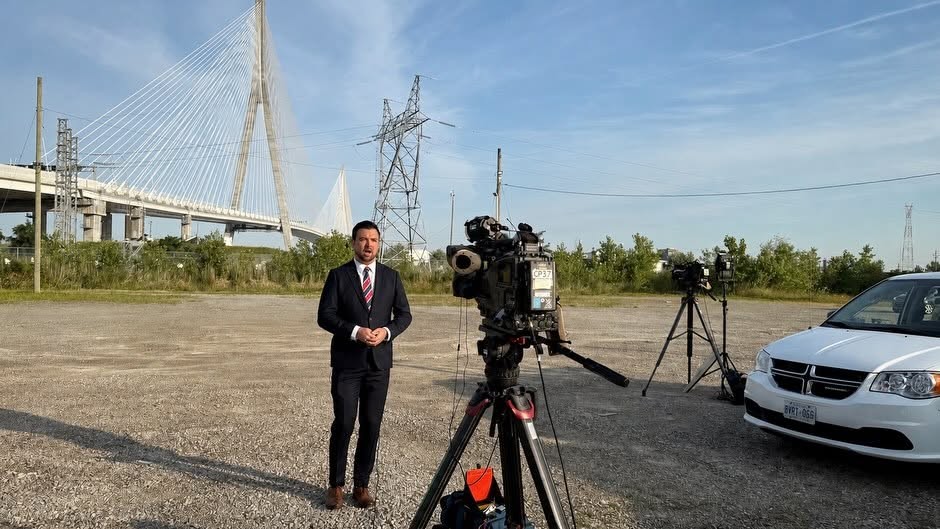
After more than a decade of construction, delays, and diplomatic wrangling, the Gordie Howe International Bridge officially opened on Canadian soil this week but the celebration looked nothing like organizers once imagined. No American officials showed up.
The absence wasn’t an oversight. Ottawa made the call on July 21, saying it would be out of step with the moment to host a joint Canada-U.S. celebration while Washington’s tariffs on Canadian goods remain in place. A shared ribbon-cutting had reportedly been in the works for months before the plan fell apart.
The $6.4-billion span will open to cars and trucks on July 27, with cyclists and pedestrians able to cross starting August 5. It connects Windsor, Ontario, with Detroit, Michigan, running parallel to one of the continent’s most heavily used trade corridors a crossing that alone accounts for roughly a quarter of all Canada-U.S. truck traffic and close to $1 billion in commerce every day.
The backdrop to the opening is a fresh round of economic friction. On July 20, President Donald Trump announced 50 percent tariffs on a swath of Canadian exports, including alcohol and dairy products. The White House pointed to Canada’s dairy supply management system, provincial rules on alcohol sales, and its automotive trade practices as justification.
Trump later addressed the snub directly on Truth Social on July 24, calling it “fine” that Canada had left the U.S. out of the opening ceremony, and framing it as a fair trade given the tariffs Canada now faces. He also took the opportunity to defend a revised revenue-sharing arrangement for the bridge, arguing the original terms negotiated years earlier had shortchanged the United States and that the new 50-50 profit split corrects that.
That renegotiation followed a U.S.-imposed delay to the bridge’s launch back in June. Under the original 2012 agreement, Canada which financed the entire project was to keep all toll revenue until construction costs were repaid, after which Michigan would begin receiving half. The new arrangement instead gives Canada half of net revenue for the bridge’s first 15 years, while the remaining half flows into a U.S.-controlled economic development fund for the region.
Despite the tension, Canadian officials used the ceremony to highlight the practical benefits the crossing is expected to bring. Housing Minister Gregor Robertson noted the bridge will operate with 24 inspection lanes on the Canadian side and 36 on the American side, cutting an estimated 850,000 hours of waiting time for carriers annually.
“That’s an achievement that we look forward to, and that adds up to billions of dollars of economic savings and thousands of jobs that are secured on both sides of the border with that efficiency,” Robertson said.
Ontario Premier Doug Ford struck an optimistic tone about the bridge’s long-term significance, calling it proof of what’s possible for workers and families on both sides of the Detroit River, and predicting the Canada-U.S. relationship would endure for generations to come.
Windsor Mayor Drew Dilkens, who has long championed the project, described his city as Canada’s automotive hub and a continental leader in tool, die, and mould manufacturing. He said the bridge cements Windsor-Detroit’s status as North America’s top international gateway for the decades ahead, and expressed hope for deeper trade ties between the two countries going forward.
Former Prime Minister Stephen Harper, whose government struck the original 2012 deal to build the bridge, marked the occasion on social media as well. He acknowledged the years of setbacks the project endured but said he was proud to see it finally open, adding that he hopes it carries forward hockey legend Gordie Howe’s legacy of bringing the two nations closer together.
For now, the bridge stands as both an engineering achievement and a symbol of a relationship under strain. Trucks and commuters will begin crossing this week, easing pressure on the aging Ambassador Bridge nearby. But the empty seats at Tuesday’s ceremony and the tariff dispute simmering behind them suggest that whatever economic gains the bridge delivers, the political relationship it was meant to symbolize still has some rebuilding to do.

