
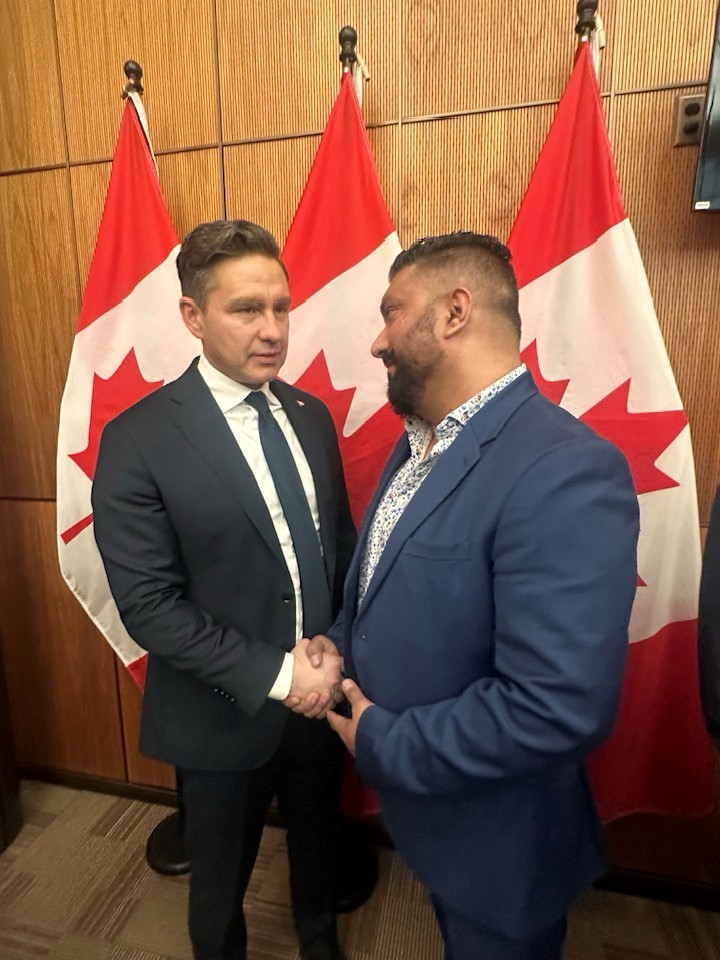
Conservative Leader Pierre Poilievre made his position clear Wednesday: Canada must dig in and negotiate a tough trade deal with the United States and resist any temptation to pivot toward Beijing as an alternative.
Speaking at the Canada Strong and Free Network conference in Ottawa on May 7, Poilievre called on the federal government to pursue tariff-free trade with Washington through hard bargaining, while drawing a firm line against what he described as a dangerous strategic drift toward China.
“We must reject the idea of a permanent rupture with our biggest customer which buys two thirds of our goods in favour of a strategic partnership for a ‘new world order’ with Beijing,” Poilievre told the audience of conservative supporters.
Much of Poilievre’s criticism was directed at Prime Minister Mark Carney’s January agreement with China, which would bring Canada’s tariffs on Chinese electric vehicles down sharply from 100 percent to a most-favoured-nation rate of 6.1 percent on 49,000 vehicles annually in exchange for China lowering tariffs on select Canadian agricultural products.
Poilievre isn’t buying it. He argued the deal offers no firm guarantee that Beijing will follow through on reducing tariffs on Canadian goods, making it a lopsided arrangement at Canada’s expense.
What makes the situation more striking, Poilievre suggested, is Carney’s own past words. During the 2025 federal election campaign, the prime minister reportedly called China the “single greatest threat” to Canada. Months later, Poilievre noted pointedly, Carney was signing what he himself termed a “strategic partnership for a new world order” with that same government in Beijing.
On the American trade front, Poilievre expressed frustration with what he called a lack of urgency from Ottawa. He warned that Canada has yet to sit down with Washington for meaningful CUSMA negotiations, while Mexico has already moved ahead.
“The Mexicans are there eating our diplomatic and economic lunch,” he said bluntly.
His remarks come after Canada’s chief trade negotiator, Janice Charette, acknowledged in April that a full resolution of CUSMA-related issues before July 1 was unlikely. Mexico began formal talks with Washington back in March and is expected to launch official bilateral negotiations in May leaving Canada watching from the sidelines.
Prime Minister Carney has maintained that Canada is ready to negotiate but equally prepared to wait for terms that genuinely serve Canadian interests. His government has also raised American violations of the existing trade agreement as part of its opening posture pointing to U.S. tariffs on Canadian steel, aluminum, vehicles, and lumber.
Poilievre used the platform to take stock of what he framed as a decade of policy victories for Canadian conservatives, even while sitting in opposition. He claimed conservatives had won the argument on inflation, the carbon tax, drug policy, crime, and resource development only to watch the Liberals adopt conservative-sounding rhetoric without delivering real results.
“Imitation without action is an illusion,” he said. “They’re not actually implementing what they promised, or the policies that they stole, and the results speak for themselves.”
He pointed to stalled major resource projects, unaffordable housing, unchecked government spending, and legislation that continues to hamstring Canada’s oil and gas sector as proof that Liberal promises have gone unfulfilled.
On quality of life, Poilievre cited Canada’s slide on the Global Happiness Index from fifth place a decade ago to 18th in 2025 and 25th in 2026. Among young Canadians specifically, the picture was even grimmer, with the country ranking 71st globally for youth happiness behind not just traditional peer nations like the U.S., the UK, and Australia, but also Kazakhstan, Vietnam, and Moldova.
Responding to critics who have characterized his style as too combative, Poilievre was unapologetic.
“That’s because some things are actually worth fighting for,” he said, framing the Conservative role in opposition as giving voice to everyday Canadians who lack political connections or media platforms.
The conference drew a notable lineup beyond Poilievre, including Alberta Premier Danielle Smith, former U.S. Secretary of State Mike Pompeo, and U.S. Ambassador to Canada Pete Hoekstra.

