
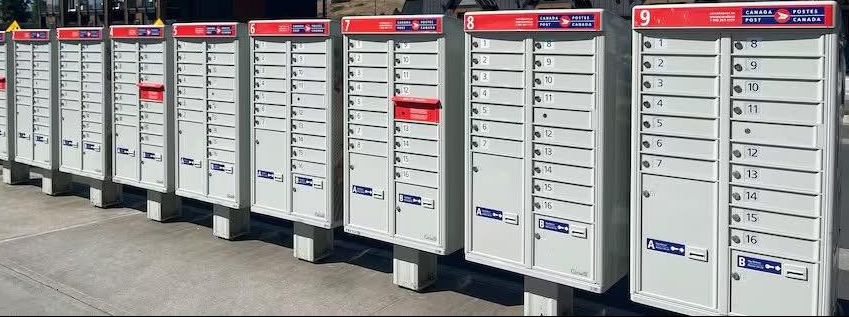
Canada Post has announced a major shift in its delivery model, revealing plans to eliminate home mail delivery for 136,000 addresses across 13 communities in the first phase of a nationwide transition to community mailboxes. The move is part of a broader restructuring strategy aimed at addressing mounting financial losses and ensuring the long-term sustainability of the postal service.
The rollout, set to begin later this year and extend into early 2027, will primarily affect neighborhoods in British Columbia and Ontario, with additional communities in Manitoba, Quebec, and New Brunswick also included. Among the most impacted areas are Ottawa, where approximately 30,000 households will see the change, and Etobicoke, Ontario, with around 18,000 addresses slated for conversion.
In British Columbia, the transition will affect roughly 23,000 homes in Vancouver, alongside thousands more in Abbotsford and Mission. Meanwhile, 19,000 households in Moncton and Riverview, New Brunswick, and 16,000 in Winnipeg will also lose door-to-door service. Quebec communities such as Sept-Îles, La Prairie, and Candiac are included as well.
Canada Post stated that the selected neighborhoods are located near areas where community mailboxes are already in use, making the transition more feasible. The process will take several months and include consultations with local residents regarding mailbox placement. The agency also emphasized that accessibility features will be incorporated, including options for individuals with mobility challenges and Braille support for those with visual impairments.
The initiative is part of a larger plan to phase out door-to-door delivery entirely over the next five years, impacting roughly four million addresses nationwide. Officials estimate that the transition could save the organization up to $400 million annually.
The changes come amid a deepening financial crisis for Canada Post, which has recorded billions of dollars in losses over recent years. The corporation reported nearly $5 billion in deficits between 2018 and 2025 and is projected to lose around $1.5 billion in 2025 alone. Government officials have described the situation as critical, warning that immediate reforms are necessary to prevent further decline.
In addition to delivery changes, Canada Post is reviewing its retail network, with potential closures or conversions of post offices in areas considered oversaturated. Delivery standards for non-urgent mail are also being adjusted, with a shift from air to ground transportation to cut costs.
However, the plan has drawn strong opposition from the Canadian Union of Postal Workers (CUPW), which has pledged to resist the changes. The union argues that the shift will not only result in significant job losses estimated at up to 40 percent in some areas but also negatively impact public service, particularly for seniors and individuals with mobility issues.
Union representatives have raised concerns about increased risks associated with community mailboxes, including theft, vandalism, and safety issues stemming from longer travel distances for residents.
Despite the backlash, government officials maintain that the overhaul is essential. They argue that declining mail volumes and rising operational costs have pushed the postal service to a breaking point, making structural changes unavoidable.
As Canada Post moves forward with its transformation, the coming months are expected to bring continued debate over the balance between financial sustainability and maintaining accessible public services.

