
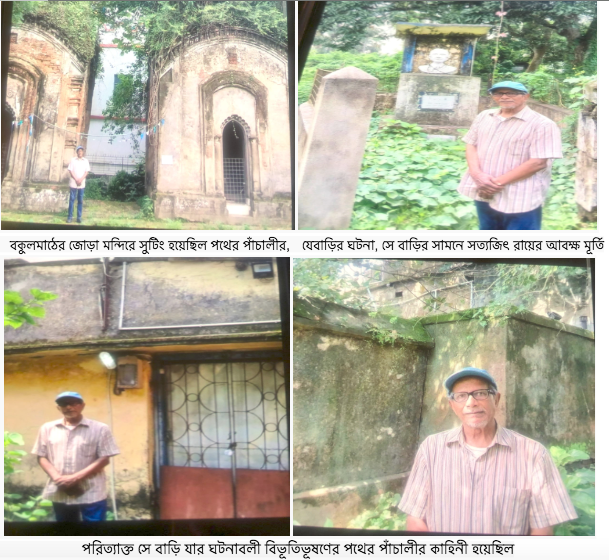
Boral is a small village near Calcutta, a very insignificant small house in the village, around that house, biographical artist Satyajit Roy built the world-winning “Pather Panchali”. It was not a village or a house I was supposed to visit, but last Saturday, 17/08/24 my inquisitive mind was drawn there. Any work that supports an excuse, I have. My younger brother Arijit told me one day that when he goes to Calcutta, he wants to visit the Panchali village where the shooting took place. I said in a disappointed tone, “Is that village still there?” He did not want to agree, said that the shooting site of the world famous film must have kept the heritage intact! My heart didn’t agree, but I came to Kolkata and rushed to Boral, I didn’t have to go so fast, I reached Garia station by metro, from there I reached Boral Gaon by auto, I came to see the famous village and village of Panchali on the famous path of Arijit’s dream. One of the greatest child-actors in the history of world cinema; Apu of Pathan Panchali. There were many demands from life. What gave him life!
Although I brought some pictures, on the way back, I kept asking myself, what is “I am no boy” really lost, “a little time and a little despair” is what it is. In fact, nothing has been saved from the government! The poor little house is still standing today, in a dilapidated state, surrounded by the forest, and despite the fear of snake bites, I went ahead and took a picture standing in front of the house, although my chest was full of fear. I can show Mr. I know his dream will be broken. Maybe someone in the area had the slightest emotion or thought, so there is a bust of Satyajit Ray on the side of the entrance to the house, lying very neglected. My feeling was that rather than dishonor it, what was needed was to build it. Meeting some people of the village on the street and talking to them, it came to know that recently this very famous house and land has been sold to my son, they don’t know what the new owner will do. A gentleman a bit older, I asked him, Dada stole a bead garland from a neighbor’s house in Panchali, Durga, after Durga died, Apu threw the malakhani in the water of the pond, kachuri pana came and covered the malakhani, in which pond did this shooting take place? The gentleman pointed and said “this is behind you”, I said where is the pond? Looking back, the forest around the pond is so covered, I had to raise my head to see the middle of the pond. Out of anger, I did not take his picture.
Why Mr. Abhijit is so interested in Satyajit Ray’s Chabi, that academically does not know Bangla? He chose Animation Film Production for his higher education, currently successfully completing the academic studies of Masters Class and directing the Animation part of two films in the Practical Field, this is a requirement to get the Masters Award. During his academic studies, Arijit researched Satyajit Ray’s films, watched almost all of his films, and gradually became a huge fan of Satyajit Ray. As children of Bengali we are proud of him.
Movie makers in Western countries (Art Film) either consider Satyajit Ray as a guru in life-oriented and realistic film production or think of him as A, B, C, D of Art Film. I am speechless. In fact, once Arijit took me to see the premiere of a film produced by his Masters’ class teacher Mr.Philiph, after watching the film, he introduced me to Mr.Philiph. Philip asked me how the film felt, I hugged him and said, “I feel like I just came out of a Satyajit Ray movie.” Philiph said yes, we are trying to follow Satyajit Ray. I was reminded of all these words while visiting the shooting site of Panchali on the way. In fact, we do not know ourselves in the subcontinent or even try to know ourselves.
Pather Panchali Real Life Pure Movie:
At the turning point in Pather Panchali’s story PC Indir Thakur, widow of distant relation of Harihar Ray (Apu, Durga’s father) comes and takes shelter in Harihar’s house. She was an old widow with no one to look after her. But Harihara’s wife Sarvajaya could not tolerate such a woman (Indira). So the old woman is given a hut to live in. But Durga, Sarvajaya’s six-year-old daughter, is very fond of Indir Tagore and would sit with him for hours listening to fairy tales.
Apu was born in Harihar’s house within a few days. Sarvajaya, Indir becomes jealous of Tagore as he feels that Durga loves Indir more than him. When Sarvajaya’s torture becomes unbearable, Indir sometimes takes refuge in another relative’s house. Durga steals fruit from her rich neighbor’s garden and shares it with Indir Thakur. One day, the neighbor’s wife comes and accuses Durga of stealing a bead necklace and convicts Sarvajaya of encouraging this theft.
Over time, Apu grows up, becoming very curious and sensitive to the beauty and mystery of nature. He is always on new adventures with his sister Durga, such as: wandering in the forest, participating in tribal games and secretly eating fruits, going out for walks. Apu-Durga gets glimpses of the outside world, which fills their minds with joy and excitement. Apu enrolls in the village school, besides studying where he hears many village elders gather and talk about various topics, many things in life overwhelm him. Apu finds variety and thrill in the monotonous flow of village life like village festivals, fairs, yatras etc.
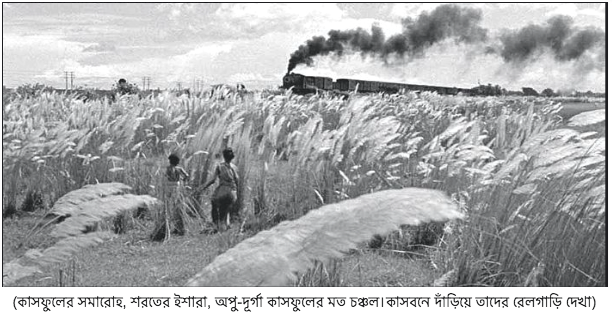
Siblings Apu and Durga are very emotional. Durga didi She also loves Apu like a mother. However, he does not leave to annoy him sometimes. Sometimes they sit quietly in the trees, sometimes they follow sweetmeats, sometimes they watch the traveling bioscope-walla’s bioscope or watch the procession. In the evening, the two enjoy hearing the whistle of the approaching train. One day they came far away from home saying to see the train. Apu-Durga’s escape to see the train at Kas Ban is one of the memorable moments of the film.
Durga dies suddenly leaving the entire family in mourning, leaving her younger brother Apu alone. Father Harihar left home for long periods and struggled desperately to earn a living. After returning home, Harihar decided to leave the village. All packed up and went to the railway station. They boarded the train and left behind forever all their memories of happiness and sorrow especially the varied life of Apu Gaon.
In the embrace of autumn, the white kasban swaying in the wind, behind which the train smokes, the name kasban is now nowhere in Nishana Gaon. The shooting took place at a pair of temples at one end of a field called Bakul Mat, the temple is still there, the god is worshiped occasionally, so maybe it survives, but people don’t come much, careless, the Bakul tree is no more, either dead or cut. The name Bakul Mat. still have
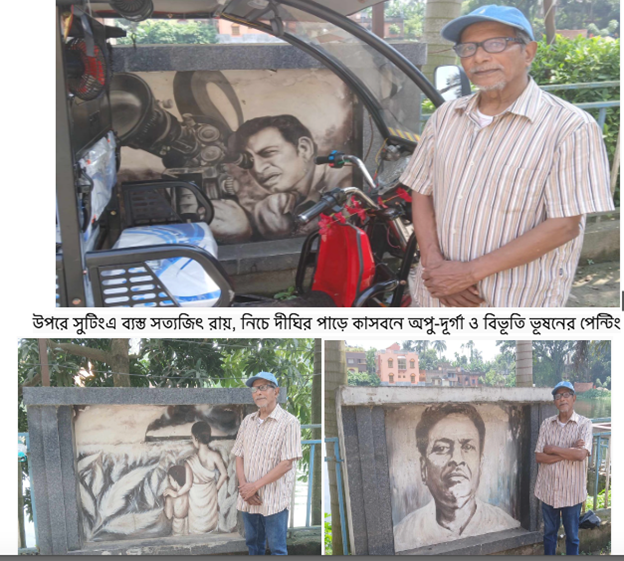
One thing was interestingly noticed, there is a Dighi near the Bakul field, although the Dighi has nothing to do with the shooting of the film, the local councilor has tied the bank of the Dighi to the road and painted the scene of Panchali between two and three paths, along with Satyajit Ray. A picture of a picture and book author Vibhutibhushan. But there is one thing that will help to remind you that there was a movie called Pather Panchali. evil is good.
Pather Panchali gained huge popularity in India as well as the world and a total of 11 international awards
achieved The film’s success was followed by two more films Aparajit and Apur Sansar, three films known as the world famous Apur Trilogy. After Pather Panchali, due to the popularity of Aparajit, more excitement was created in the international arena. Although Satyajit created the new context of Bengali cinema in black-and-white films, he is equally acclaimed for making Kanchenjunga, the first color Bengali film in 1962. Against the superstitions of Hindu society, Devi Bhatti produced more than 35 films in his lifetime, including Charulata-Nasthanid, Mahanagar, Abhiyan, Kupurush and Mahapurush, Ganashakti and Agantuk. Moreover, Baal entertains all the elders by making Gopi Gain Bagha Bain and Hirak Raja in the country suitable for the younger ones.
In his career in the colorful film world, the fearless and brave actor has been awarded many awards including Bharat Ratna, Dadasaheb Phalke Award, Oxford University Honor and Academy Oscar.
movie maker
Today, Satyajit Ray is immortal by bringing creative works of art to the world court, we as Bengalis are proud of him.
I was supposed to go to Bangladesh via Delhi, Kolkata on this trip, but due to the situation that arose, I did not dare to go to Bangladesh. In that context, I decided to witness some interesting historical monuments of ancient heritage in Kolkata or nearby. My visit was part of that.

