
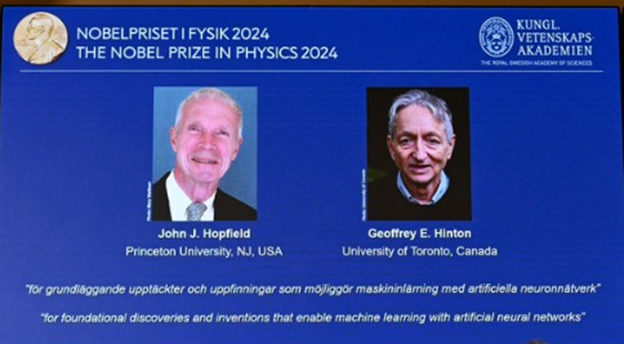
Last Tuesday, October 8, the Royal Swedish Academy of Sciences awarded Geoffrey E. of the University of Toronto for their fundamental innovation in machine learning with artificial neural networks. Hinton and Princeton University of America John J. Hopfield was awarded the 2024 Nobel Prize in Physics. Hinton also notably warned in 2023 that AI superintelligence could pose a particular threat to humanity. The message made headlines in various media including Toronto’s Banglamail. Inevitably, this Nobel win surprised many scientists around the world, including Hinton.
So Hinton said in a telephone interview during a live announcement press conference with members of the Royal Swedish Academy of Sciences streamed on YouTube, “I’m shocked! I had no idea this was going to happen. I’m absolutely amazed!”
Two scientists, Geoffrey Hinton and John Hopfield, jointly won the Nobel for their groundbreaking work on machine learning in physics. Canadian Professor Hinton has been referred to as the “Godfather of AI”.
Professor Hinton’s pioneering research on ‘neural networks’ paved the way for current AI systems such as ChatGPT. Neural networks in artificial intelligence are systems that closely resemble the human brain in the way it learns and processes information.
They are also able to learn from the AI’s accumulated experience, just as a person would. This is called deep learning.
Some important applications of the two scientists’ work are listed, including climate modeling, solar cell development, and medical image analysis.
Hopfield developed an associative memory that can store and reconstruct images and other types of patterns in data. Hinton developed a method that can autonomously find features in data and perform tasks such as identifying specific elements in images. The work of the two award winners is closely linked.
Techniques introduced by Hopfield and Heaton and the idea that biological neural networks are found in animal brains. has greatly simplified and simplified the processes and proved to be effective. which underlies much of today’s machine intelligence in the AI field.
Hopfield, a 91-year-old theoretical biologist with a background in physics. In 1982, he made a breakthrough by creating a network. which describes the connections between nodes as real forces, just as we describe various natural processes. His invention, known as the Hopfield network, uses physics concepts that describe how atomic spins behave in matter.
Hopfield and Hinton’s research, in the early 1980s, made modern machine-learning techniques a reality. The principles of physics were applied to develop such methods. Their work enabled computers to perform tasks such as image recognition and pattern completion. A capability that is now ubiquitous in everyday technology.
Strategy drawn by physics:
The win has already shocked many on social media and scientists, as it seems unusual to them that research in computer science like machine learning can win the Nobel Prize for Physics! “The 2024 Nobel Prize in Physics that has been announced does not go…” tweeted German physicist Sabine Hosseinfelder.
But from the Nobel committee’s point of view, the prize came mainly from the fact that the two men came from statistical models used in physics and partly from recognition of the progress in physics research that came from using neural network techniques as research tools.
“Artificial neural networks have been used to advance research in physics topics as diverse as particle physics, material science and astrophysics,” Nobel committee chairman Ellen Moon, a physicist at Sweden’s Karlstad University, said during the announcement.
Not only the efforts of famous scientists:
It’s worth noting that both of today’s laureates have deep histories in science, which extend beyond their contributions to their Nobel Prize wins. Hopfield’s influence spanned many fields, as his early work bridged physics, biology, and computation. Beyond the well-known Hopfield network, he made important advances in understanding how neural systems store information processes, forming basic theories of brain-like computation.
Hinton’s involvement in artificial intelligence dates back to 1972, and his achievements have significantly shaped modern generative AI. In 1987, Hinton, David Rumelhart and Ronald J. With Williams, helped bring attention to backpropagation, a key neural network training method fundamental to today’s generative AI (AI) models. In 2012, Hinton collaborated with Alex Krzyzewski and future Open AI (AI) Chief Scientist Ilya Sutskever to develop AlexNet. An important innovation in computer vision and deep learning that is widely credited with ushering in the current era of AI. In 2018, Hinton was awarded the Turing Award – often considered the “Nobel Prize of computing” – alongside Yoshua Bengio and Ian LeCun.
Hinton’s ‘GOOGLE Abandonment and Concerns About AI’:
Canadian artificial intelligence pioneer Geoffrey Hinton said he left Google because of recent discoveries about AI, which he realized would threaten humanity over time. CBC chief correspondent Adrienne Arsenault talks about the risks associated with the ‘Godfather of AI’ and whether there are ways to avoid them.
The win is perhaps all the more interesting because Hinton, often called the “godfather of AI,” resigned from Google in May 2023 so he could “speak freely” about the potential risks of AI systems. At the time, Hinton said the tech industry’s further development of AI products could have threatening, even dangerous consequences for humanity.
From the 1980s, Dr. Hinton was also a professor of computer science at Carnegie Mellon University, but he later left the faculty because he was reluctant to pursue Pentagon-funded research.
By the year 2023, Hinton’s anxiety grew even more, when he noticed the rapid progress of artificial intelligence (AI). He thought it would take 50 years or more for artificial general intelligence to advance. However, in March 2023, he told CBS News that it would not be another 20 years before the use of “general purpose artificial intelligence” begins. This will bring about what may be called “radical changes similar to the Industrial Revolution or the invention of electricity.”
In an interview with the New York Times on May 1, 2023, Hinton said, “I resigned from Google because of the impending dangers and dangers of artificial intelligence, and the impact it will have on Google!” He is also fearing and taking into account competition from Google and Microsoft.
Geoffrey Hinton, called the godfather of (AI), had been working with Google for a decade, apart from teaching. Recently, he quit his job so that he can warn the world about the dangers of (AI), how it can harm humanity.
Risks from General Artificial Intelligence:
While the takeover of artificial intelligence is worrisome, it’s not inconceivable that its particular application could pose a threat to humanity, Hinton thinks. Its methods and applications can be important organizations such as military and economic purposes. His concern is that general artificial intelligence, uncoordinated with programmers’ interests, will be able to penetrate different target centers at the same time. “We have to think about how to keep the entire enforcement system under control,” says Hinton.
Apocalypse can be misused:
The hardest thing to date is to identify someone who wants to abuse. Hinton therefore called for an international ban on lethal autonomous weapons.
Economic impact is inevitable:
Hinton, previously optimistic about the economic impact, thought a robot with general artificial intelligence could do more work than any human could. Now he says that’s not the case. The robot will perform many routine tasks but will require human assistance or not be redundant. However, the labor market will continue to shrink as robots will replace drudgery.

