
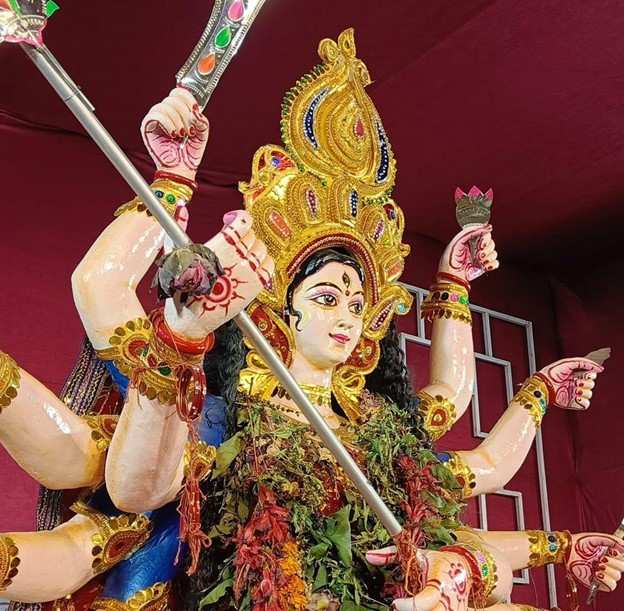
Two opposing forces are at work in the world. Saves a world, leads the way to prosperity. It is divine power. The other tries to lead to the path of evil, the path of destruction. It is demonic power. The battle of these two forces is constantly going on inside and outside of us. This conflict is imagined as Devasura Sangram. Durga Puja is an offering of devotion to the victory of good power over evil power. A prayer for release from Tamsa to Jyoti.
In the Skanda Purana, Mahadevi killed the mighty Asura in battle and said-
“অদ্য প্রভৃতি মে নাম দুর্গেতি খ্যাতিমেষ্যতি।
দুর্গদৈত্যস্য সমরে পাতনাৎ অতি দুর্গমাৎ।।”
‘দুর্গম দুর্গদৈত্যকে যুদ্ধে পতিত করায় আজ থেকে আমি ‘দুর্গা’ নামে খ্যাত হব।’
Durgarupini Shakti established Nyayadharma in Vindhyachalparvata, while Nagadhiraja in Himalayas defeated the evil power of Mahishasurupi. So Durga Mahishasuramardini. He is Durgtinashini because he destroys the misfortunes of the world. Although the goddess killed other demons, Mahishasuramardini idol is worshiped in Bengali society. In the Indian subcontinent, Durga Puja was not practiced anywhere else except in Bangladesh. In Bengal, Durga murti has been found from two sides to eight sides. Since the 16th century, idol worship of Durga has been going on in the Bengali society.
Basanti Puja held in Chaitramas is said to be the real Mahadevi Puja. Mithila scholar Bachaspati Misra (1425-1480 AD) recorded the method of worship of Mrinmayi Pratima in his books ‘Kriya-chintamani’ and ‘Vasanti-pujaprakarana’.
It is famous that Sri Ramachandra performed the premature worship of the first goddess in the autumn of Ravanavadha in the Treta Yuga in the wish of Mahamaya. Bodhanmantra of Durga Puja has –
“Ravanasya Binashaya Ramsyanugrayaya Cha Akale Bodhita Devi”
In the Krittivasi Ramayana both Ravana and Rama were devotees of the goddess. In worship of Rama, Preet Devi abandoned Ravana. Valmiki-Ramayana does not have this narrative. The autumn Durga Puja is not the imagination of Krittivas. He took this narrative from the Bhagavata-Purana.
In the modern era, during the reign of Emperor Akbar in 1580 AD, the son of Kullukvatta, the annotator of Manusanghita, Raja Kangsanarayan of Tahirpur, one of the famous Barobhuia districts of Bengal, celebrated Jaganmata prematurely in the first autumn. However, according to Sri Sri Chandi, Surath and Samadhi perform Devi Puja in the first autumn. According to Devi-Bhagavata, Durga Puja originated in autumn.
Chandipath is an integral part of Devi Puja. Chandi is recited regularly in fifty-one devipeeths or Shaktisadhanakshetras. Chandi has some similarities with the Gita. Chapters twenty-five to forty-two of the Bhishma Parva of the Mahabharata are known as ‘Shrimad Bhagavad Gita’, an exhortation to Brahma Vidya. Chapters eighty-one to ninety-three of the Markandeya Purana are known as ‘Devi Mahatmya’ and ‘Sri Srichandi’. Gita consists of seven hundred verses, Chandi also consists of seven hundred verses. One name of Chandi is ‘Durgasaptashati’ as Sri Sri Chandi is divided into seven hundred mantras for offering seven hundred offerings at Durgahome. In Chandi Brahmarupa Mahamaya reappears in Asuravadhartha to establish Nyayadharma, in Gita Sri Krishna is said to appear from time to time to destroy evildoers to establish Dharma.
Goddess-worship is mentioned in both the epics Ramayana and Mahabharata. In the Ramayana, Sri Ramachandra worshiped Mahamaya to gain the support of Mahamaya in Ravanavadha, in the Mahabharata, Sri Krishna advised Arjuna to bow down and pray to Durga Devi before starting the battle for victory in the Kurukshetra war.
Saktisadhana has been practiced in India since prehistoric times, as evidenced by numerous deities found in the ruins of the 5,000-year-old Harappan and Mohenjo-daro civilizations.
From the ‘Devisukta’ (Rik-10/125) and ‘Ratrisukta’ (Rik-10/127) of the tenth chapter of the Rikveda, it is evident that Shaktisadhana existed in the Vedic period as well. According to tradition, ‘Ratrisukta’ is read before Chandipath and ‘Devisukta’ after.
The origins of matri sadhana are rooted in the five thousand year old Ashtamantra ‘Ratrisukta’. Sukta’s sage Kushik and deity Ratri. Ratrisukta is the oldest shakti mantra, the archetype of night goddess Kali. Ratrisukta is a vivid expression of the mystical fear that Ghankrishna Nisha used to inspire in the forested settlements of ancient Indians. The power of darkness is insurmountable, so the sage prays to the night goddess for protection from the dangers of the night. Sage Kushik’s praise of primordial power initiated India into the first Matri Mantra.
“The all-pervading Bhuvaneshwari Devi created the universe and enjoined it to bestow upon the creatures according to their actions”. ‘The Immortal Goddess Nitya Ratridevi (Mahamaya) pervaded the universe with her self-consciousness. He dispelled darkness by light. “Night brothers and sisters destroy the veiling power of the manifest dawn (Avidya)”. “Just as a bird spends the night safely in the shelter of a tree with the offerings of Goddess Bhuvaneswari, we will be able to establish ourselves in our own form”. “As boys sleep undisturbed by the infinite mercy of the mother, so animals are absorbed by the grace of the merciful goddess of the night.” ‘O night, the unconsciousness of the darkest night has come to me’. ‘O Usha Devi, remove my ignorance just as you free me from debt by giving wealth to the praisers’. You are the daughter of the all-pervading Supreme Lord. With your bosom I will conquer the enemies of lust’.” (Ratrisukta 1-8)
Although the Ratrisukta does not directly refer to the Kali-form of Chandi, the Ratrisukta is considered to be the earliest allusion to Kali in Vedic literature. During Chandi Path, nightly reading is done because night and Chandi are considered identical. Chandi, Durga and Kali are different forms of Brahma Shakti or Parashakti, the ruler of the universe. Chandi mentions Tamsidevi in connection with Madhukaitava slaying.
Sister Nivedita thought that the third verse (10/129/3) of the Nasdiya Sukta of the Rikveda contained the seed of Kalipratima – “tama asittamsa gudhamgre” – ‘first darkness was covered by darkness’. The sutta was a favorite of Swami Vivekananda. It is pertinent to mention that in Rabindranath’s ‘Kalpana’ poem ‘Year’s end’, ‘The day went from darkness to darkness’.
Perhaps Vedic and Tantric practices were two parallel streams. At some later time the Tantric school came under Vedic dominance. ‘Devisukta’ is the union of Vedic and Tantric dual thought. Brahmavidushi Bak, the daughter of sage Maharishi Ambhrin of Ashtamantratmika Devisukta and the deity Parabrahmayai Adyashakti or Sacchidananda Paramatma. This Vedic sukta is said to be the union of the two streams because the tantra-problem Mahashakti is worshiped by its chanting. Suratha Raja and Samadhi Vaishya worshiped Mahashakti by chanting this Sukta.
The speaker felt Brahma Shakti as his own soul and said,
“I have all the gods and goddesses in me. I am Brahmamayi Adyadevi and Visveshwari. I exist as life in all. It is in my power that the senses are active. I fight for the welfare of devotees. Having transcended the sky and the world, I have assumed the form of the entire world in my glory”. (Devisukta 1-8)
If the meaning of this mantra is understood, it is felt that the Mahashakti mentioned in the Tantra Shastra has manifested Himself as the Absolute through Rishikanya. Sayanacharya, the commentator of Vedas, says that in Devisukta Bak himself felt unity with the Supreme Soul and praised himself and that Supreme Soul. As a result, the Tantra-presupposed Parashakti has been praised in the praise of the Veda-presupposed Paramatma. So Paramatma and Parasakti are identical. Both views are deified as being indicative of the same great truth. The essence of the entire Tantra Shastra lies in Chandi. All the theories found in the Chandi Granth are contained in the Devisukta. The sukta simply reveals the power, majesty, vastness and action of the goddess.
Brahman and Tatsakti Abheda – This Shaktsiddhanta is first found in Vedic literature in an anecdote from the Kenopanishad. The natural forces known as deities have no power of their own, they are empowered by the power of Brahman. Once in a Devasura-fight, Brahma defeated the Asuras. But the gods thought that this victory was theirs. Brahma appeared in the guise of Yaksha and placed a piece of wood before the gods as a test of strength. Agni and Vayu with all their might could not burn or blow away the little piece of grass. When Shakti Garva was reduced, they realized that only if they were strong in Brahmabola, they were able to use their own power. The gods sent Indra to find out the identity of Yaksha. Yaksharupi Brahma became Tirohit and appeared as Divine Strimurthy as Haimavati Umarupini Brahmavidya.
Sri Sri Chandi’s Narayani Stuti mentions that Brahma Shakti is manifested in a female form. According to Devi Bhagavatam, energy exists in the form of soul in all beings. Parampurusha Dwidha is divided into Satchidananda and Parasakti. But they are essentially the same.
‘সেয়ং শক্তির্মহামায়া সচ্চিদানন্দরূপিণী।
রূপং বিভর্ত্যরূপা চ ভক্তানুগ্রহহেতবে।।‘
সেই সচ্চিনান্দরূপিণী মহামায়া পরাশক্তি অরূপা হয়েও ভক্তকে কৃপা করার জন্য রূপ পরিগ্রহ করেন।
‘সদৈকত্বং ন ভেদেহ্স্তি সর্বদৈব মমাস্য চ।
যোহ্সৌ সাহম্ অহং যাসৌ ভেদোহ্স্তি মতিবিভ্রমাৎ।।‘
আমি ও ব্রহ্ম এক। উভয়ের মধ্যে ভেদ নাই। ভেদ ভ্রমকল্পিত।
Sri Ramaprasad and Sri Ramakrishna have beautifully expressed Mahamayattva in a single sentence – Brahma is Kali and Kali is Brahman. What the Vedantists call Brahma, the Tantrics worship as Jagajjanani Mahamaya. Brahman and Mahamaya are indistinguishable.
Kali is the light of the black night. The world is dark at the beginning of creation, so he is black. All colors come and blend into black so the goddess is black. Dawn is born from night. He is darkness, and He destroys darkness, and finally He gives salvation. So the end of Ashwini Krishna Paksha is after new moon in Timirbidari Shukla Paksha Sharadiya Devibandana period. And Kali Puja is done in Dipanbita festival. He became a light and dispelled the deepest darkness of ignorance with the beacon of knowledge.
রাত্রিসূক্তের প্রতিধ্বনি জীবনানন্দ দাশের ‘বনলতা সেন’ কাব্যে-
“আলোর রহস্যময়ী সহোদরার মতো এই অন্ধকার” (‘নগ্ন নির্জন হাত’)
রাত্রিসূক্তের উপস্থিতি কাজী নজরুল ইসলামের শ্যামাসংগীতে –
“কালো মেয়ের পায়ের তলায় দেখে যা আলোর নাচন।“
রাত্রিসূক্তের দূরাভাস রবীন্দ্রকাব্যেও-
“অমানিশা গেল ফাটিয়া-
তোমার খড়্গ আঁধার-মহিষে
দুখানা করিল কাটিয়া।“ (‘সুপ্রভাত’)
তমসো মা জ্যোতির্গময় (বৃহদারণ্যক-১/৪/২৮)
Take me from the unconscious whale to the light!

