
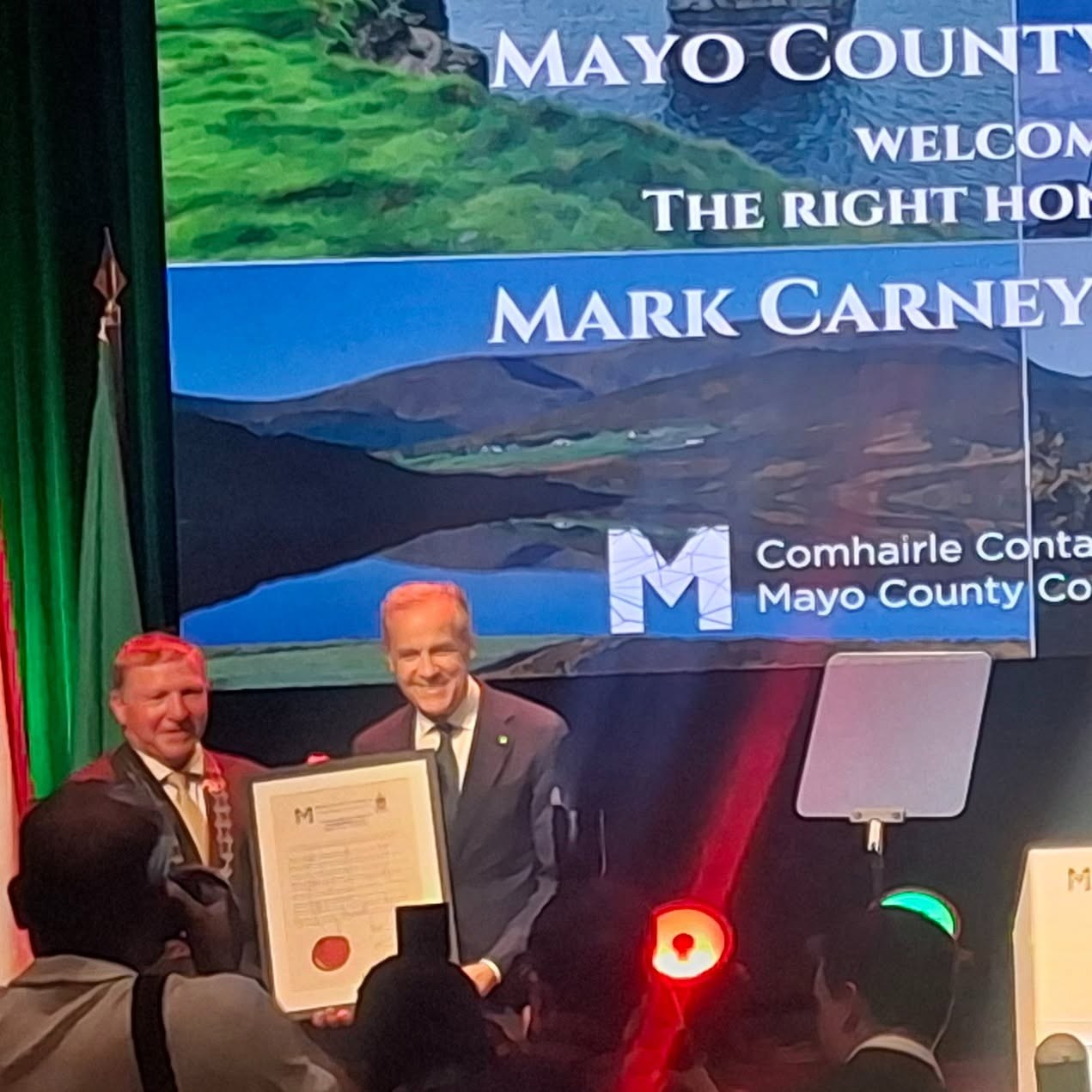
Canadian Prime Minister Mark Carney left Dublin on Saturday having deepened ties with Ireland across a range of sectors from artificial intelligence and food security to biotech and skills training while also using the trip to lay out a broader geopolitical vision of Canada, Ireland, and Europe as a unified force in an increasingly unpredictable world. Whether the visit amounted to a diplomatic breakthrough or a well-choreographed photo opportunity, however, depends entirely on who you ask.
Carney’s talks with Irish Taoiseach Micheal Martin in Dublin produced commitments to expand collaboration on several fronts, with the two leaders agreeing to advance plans for a regenerative medicine hub based in Ireland a centrepiece of the health and biotech agenda Carney has been building into Canada’s international economic strategy. Carney described the existing relationship between the two countries as “already flourishing,” while signalling that there was more runway ahead. Both governments also reaffirmed their shared commitment to the EU–Canada trade relationship and to the kind of stable, predictable, rules-based international commerce that has been under strain in recent years.
The centrepiece of Carney’s Dublin schedule was a speech at Trinity College Dublin, where he delivered the inaugural De Chastelain Public Lecture a newly established series named in honour of General John de Chastelain, the retired Canadian general and diplomat who played an instrumental role in the Northern Ireland peace process. De Chastelain chaired the Independent International Commission on Decommissioning, the body that oversaw the disarmament of paramilitary groups in the wake of the Good Friday Agreement. The choice of setting was deliberately symbolic: a Canadian leader honoured by an Irish institution for Canada’s contributions to peace on the island of Ireland.
During the lecture and an adjoining geopolitical panel discussion, Carney turned his attention to the G7 summit in Évian-les-Bains, France, which opens on June 15 and which he will attend. He described the summit as a potential weaving point for the “strands” of what he called “a new world order” a phrase he has used with increasing regularity on the international stage. Notably, Carney welcomed the fact that this year’s G7 will include a wider circle of nations beyond the core membership, citing Brazil, India, Egypt, and Gulf states as participants who would bring, in his words, “a broader perspective and a broader element of the solution.”
The Dublin remarks are consistent with a foreign policy posture Carney has been developing since taking office. His January trip to Beijing where he said Canada’s new partnership with China positions the country well for “the new world order” was followed almost immediately by a speech at the World Economic Forum in Davos, where he indirectly took aim at U.S. trade policy and called on middle powers to present a united front. Now in Europe, that message is being reinforced at every stop. Earlier this week, Carney met with French President Emmanuel Macron in Paris before travelling to Dublin.

